Decor
The Shaped Rug Trend: What Is an Irregular Rug, and Which Room Suits One?
Rugs and wall pieces cut into clouds, drops or free-form blobs: which rooms and styles they suit, how to size and place them, and why tufting makes these shapes easy.
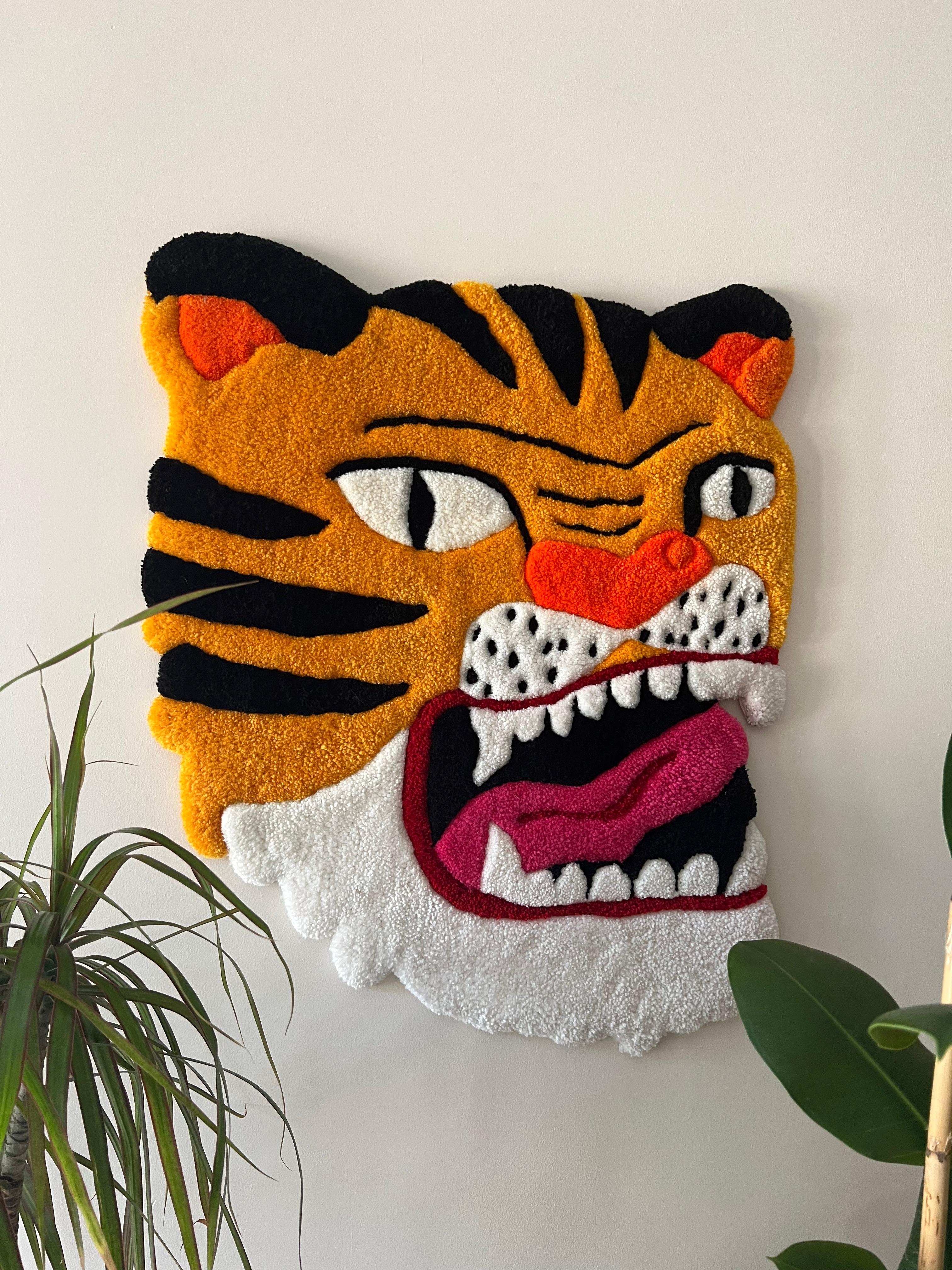
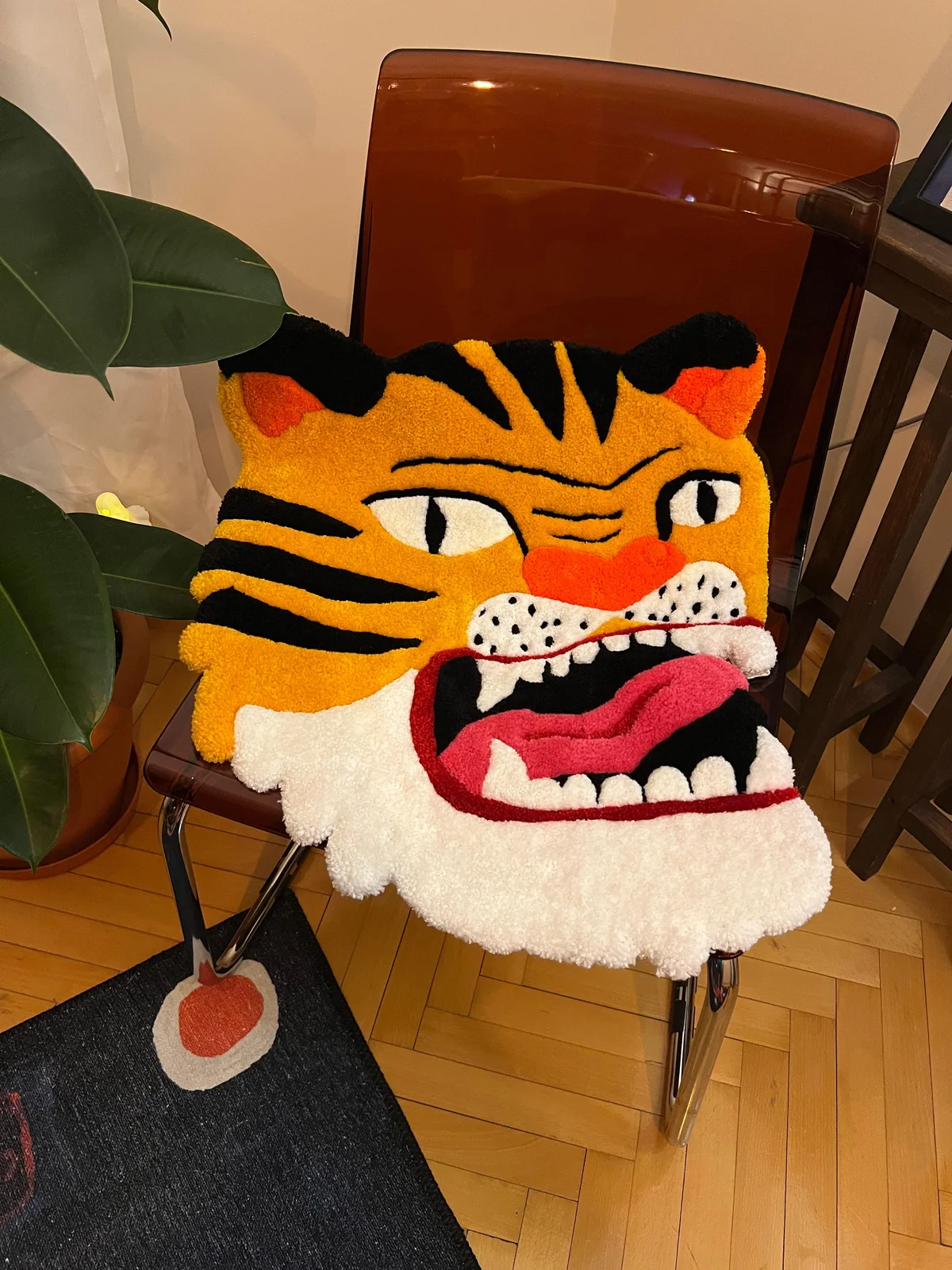
An irregular rug is one cut to an organic, free-form outline instead of a rectangle or circle: a cloud, a drop, a blob with a wavy edge, or the silhouette of an object. It works best in modern and minimal rooms with straight-lined furniture, and in small spaces it looks lighter than a rectangle. Tufting makes this kind of shape easy, because the design is drawn on the cloth first and the rug is cut along that line. There is no rectangular loom setting the limits.
What is an irregular rug?#
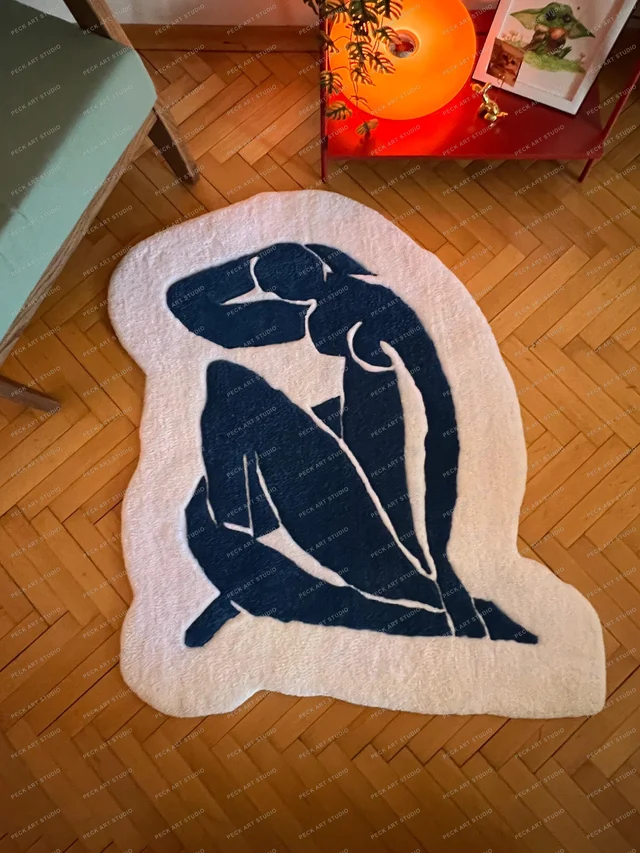
A rug whose outline does not follow a geometric shape is called irregular, shaped, organic or simply a blob rug. The forms I draw most often in the studio:
- Organic blob: a free form with soft, undulating edges and no corners. This is the best-known version of the trend.
- Mirror shape: the rug equivalent of the wavy-edged mirrors that became common in recent years; tall, narrow and slightly asymmetric.
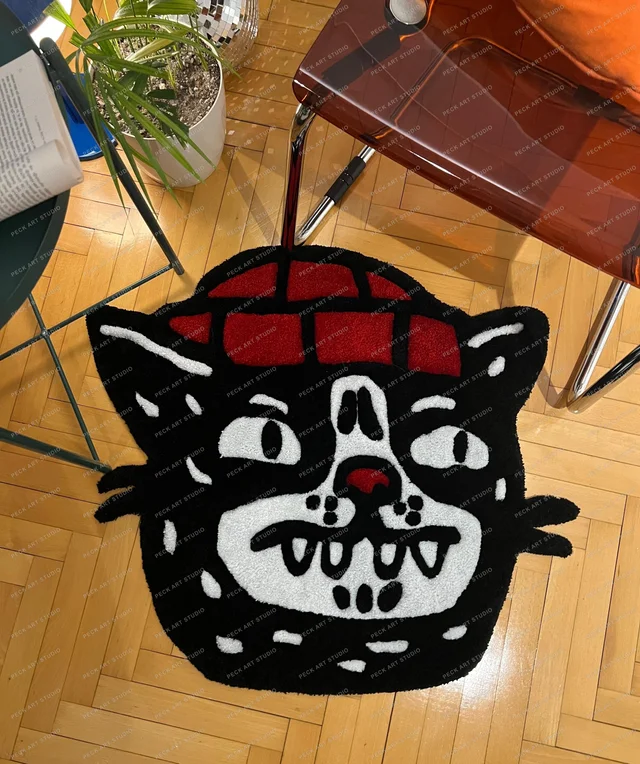
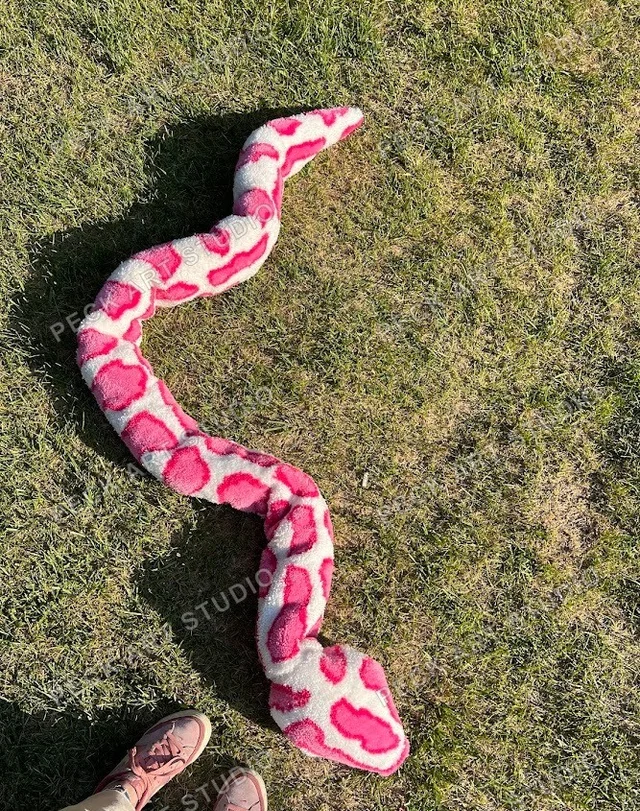
- Object silhouette: a leaf, a lemon slice, a moon, a cloud, the outline of an animal.
- Broken geometry: straight edges, but no two angles equal, as if torn from paper.
- Two-part form: two shapes touching or overlapping, such as a circle cut by a wave.
The shape can continue inside the rug too. Two or three bands of colour running parallel to the edge make the form read more clearly.
Which room suits a shaped rug?#
The short answer: rooms with straight-lined furniture, a plain floor, and space for the rug to be the one accent. Room by room:
- Living room: under the coffee table or in front of the sofa. Between a rectangular sofa and table, an organic form softens all the straight lines.
- Bedroom: beside the bed, where your feet land first. A narrow, long drop or cloud shape works well here.
- Study corner: in front of a reading chair rather than under a desk, since chair casters can catch on an indented edge.
- Entrance and hallway: a long, narrow form can greet you at the door, provided it stays clear of where the door swings. For the hallway as a whole, see hallway and entrance wall decor.
There are places it does not suit. In bathrooms, or in front of a kitchen sink, a tufted rug's adhesive backing suffers from constant moisture, so I do not recommend a shaped rug there.
Which decorating styles work with a shaped rug?#
The best match is modern, minimal, Scandinavian and 70s-inspired retro rooms. Their surfaces are plain, so the rug's outline gets noticed.
In a classic room with ornate furniture, an irregular form either gets lost or looks out of place. There, either bring the rug's colour close to the room's dominant tone or move the shape onto the wall.
I wrote about matching style and artwork more broadly in choosing art by decorating style. If colour is the sticking point, choosing art by colour palette will help.
How do you size and place a shaped rug?#
Measure a shaped rug at its widest and longest points, in other words by the imaginary rectangle around it. Then these rules help:
- In front of a sofa: make the widest point about two thirds of the sofa's length. For a 210 cm sofa, around 140 cm looks balanced.
- Under a coffee table: the rug should extend at least 25 to 30 cm beyond the table on every side. Less than that looks like a doormat squeezed underneath.
- Beside a bed: 60 to 90 cm wide is enough for where your feet land, and the length can be around half the bed's.
- Distance from the wall: keep the nearest point of the rug 20 to 30 cm in from the wall. An organic form pushed against a wall looks cramped.
- Walkways: keep the indented edge off the line people walk most. Even without a lifted edge, an irregular outline can mislead a foot.
The organic form has one advantage: it does not need to be centred on the sofa or table. A slightly offset placement suits its looseness.
For general living room sizes there is a detailed breakdown in what size rug and painting for a living room.
Should a shaped rug go on the floor or on the wall?#
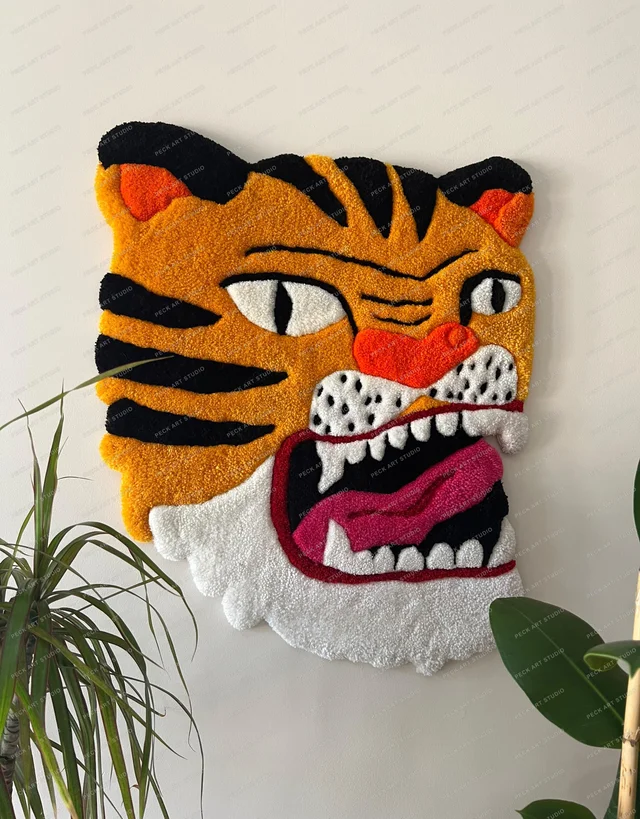
Either works, but the wall sets fewer limits. A floor rug's shape needs to be simple enough to survive foot traffic and the vacuum cleaner. A wall piece can have much finer extensions, deeper indents and longer pile.
On the floor, watch two things. First, slipping: on parquet or tiles you need a non-slip backing or a suitable pad underneath; I compare the options in rug pads and non-slip underlays. Second, the vacuum: indented edges can catch on the head, so pull the vacuum from the inside outwards along the edge.
On the wall, a shaped piece can still hang from a straight batten hidden behind the form. Hanging methods are in how to hang a wall rug.
Why is tufting good at shaped rugs?#
Because in tufting the drawing sets the rug's boundary, not the loom. A woven rug builds up row by row between warp threads and is rectangular by nature. Getting a shape from it means cutting, and a cut woven edge starts to unravel.
In tufting the process goes like this:
- The form is drawn on tufting cloth at full size.
- Loops are placed only inside the form; the cloth outside stays empty.
- Adhesive goes on the back and locks the loops in place.
- The cloth is cut with a margin of 3 to 5 cm outside the form.
- That margin is folded back and glued, and a second backing following the shape goes on top.
So however free the outline, the edge does not unravel. The full process is in how a tufted rug is made.
There are limits. On a floor rug, necks narrower than 8 to 10 cm and very tight inside corners stay weak, because the folded margin puckers there. If a drawing has a spot like that, I usually suggest widening it slightly.
What does the price of a shaped rug depend on?#
The price is calculated from the area of the rectangle around the form, the level of detail and any extras. A heavily indented outline takes longer to finish at the edge. You can see the current range in the calculator on the custom order page once you choose a size and technique.
Finished tufted work is on the tufting page. If you have a form in mind, a rough sketch on paper and a photo of it is enough; attach it as a reference on the custom order page and we will refine it together.
Frequently Asked Questions
Which room suits a shaped rug?
Rooms with straight-lined furniture and a plain floor: under the coffee table in a modern or minimal living room, beside the bed, in front of a reading chair. Constantly wet areas such as bathrooms or in front of a kitchen sink do not suit a tufted rug.
How is a shaped rug measured?
At its widest and longest points, meaning the imaginary rectangle around it. In front of a sofa, a widest point of about two thirds of the sofa length looks balanced; under a coffee table, the rug should extend at least 25 to 30 cm beyond it on every side.
Does the edge of an irregular rug unravel?
Not in tufting. The loops are locked with adhesive on the back, the cloth is cut with a 3 to 5 cm margin, folded back and covered with a second backing that follows the shape. On a floor rug, only necks narrower than 8 to 10 cm can stay weak.
Can a shaped rug be hung on the wall?
Yes. Despite its irregular edge, it can hang from a straight batten hidden behind it. On the wall the form can be freer: thin extensions, deep indents and long pile that would struggle on the floor are no problem.