Decor
What Size Rug and Picture for a Living Room? A Sizing Guide
What size rug for a living room, what size picture for a wall? Practical calculations based on your sofa, common dimensions, and the sizing mistakes people make.
Updated:
The most expensive mistakes in decorating are sizing mistakes. You can get used to a colour you did not love; a size you got wrong never settles. This article sets out the practical way to decide on rug and picture dimensions for a living room, with numbers.
One rule summarises the whole piece: when in doubt, go bigger. Undersized pieces shrink a room; oversized ones rarely cause trouble.
Rug size: start from the sofa#
Rug size is calculated from the seating group, not from the walls. There are three common layouts.
In the first, the rug sits under all the furniture. All four legs of every seat rest on it. It is the most generous and most expensive solution and works beautifully in large rooms. For this, the rug needs to extend at least 20 cm past the outer edges of the group in every direction.
In the second, only the front legs sit on the rug. Front legs on, back legs off. In most mid-size living rooms this is the most balanced solution. The rug should be slightly wider than the sofa.
In the third, the rug defines only the central area. No furniture stands on it; it sits under the coffee table. This works in small rooms and tight spaces.
Common living room rug sizes#
Practical equivalents for typical room sizes:
- Small room, two-seater and an armchair: 80x150 or 100x150 cm
- Mid-size room, three-seater and an armchair: 120x180 or 140x200 cm
- Large room, corner suite: 160x230 cm and above
- Defining the coffee table area only: 80x120 cm
In custom production any size between 20 and 200 cm is possible, so you are not obliged to fit a standard. The most requested commission sizes are 80x120 and 100x150.
The distance in front of the sofa#
An easily missed detail: how far the rug extends from the sofa.
The coffee table should sit entirely on the rug, all four legs. If half of it hangs off, the rug is too small.
The rug should run uninterrupted between the sofa and the armchair opposite. A strip of bare floor in the middle splits the seating group in two.
Picture size: two thirds of the furniture#
For wall pieces, a single ratio solves almost every case.
The piece should be about two thirds the width of the furniture beneath it. Some examples:
- 180 cm sofa → a piece around 120 cm wide
- 240 cm sofa → around 160 cm, or two 70x100 pieces side by side
- 120 cm console → around 80 cm
- 160 cm bed → around 100-110 cm
If you are hanging more than one piece, the calculation uses total width: including the gaps, the group should span two thirds of the furniture.
Hanging height#
Two numbers are enough:
- The centre of the piece 145-150 cm from the floor. That is average eye level and the standard galleries use
- If it hangs above furniture, the bottom edge 20-25 cm above it
Where the second rule conflicts with the first, the second wins. The piece should read as a group with the furniture; open up the gap and they become two separate objects.
In rooms with high ceilings the centre can rise a little, but going above 160 cm detaches the piece from the room.
How much of the wall it should occupy#
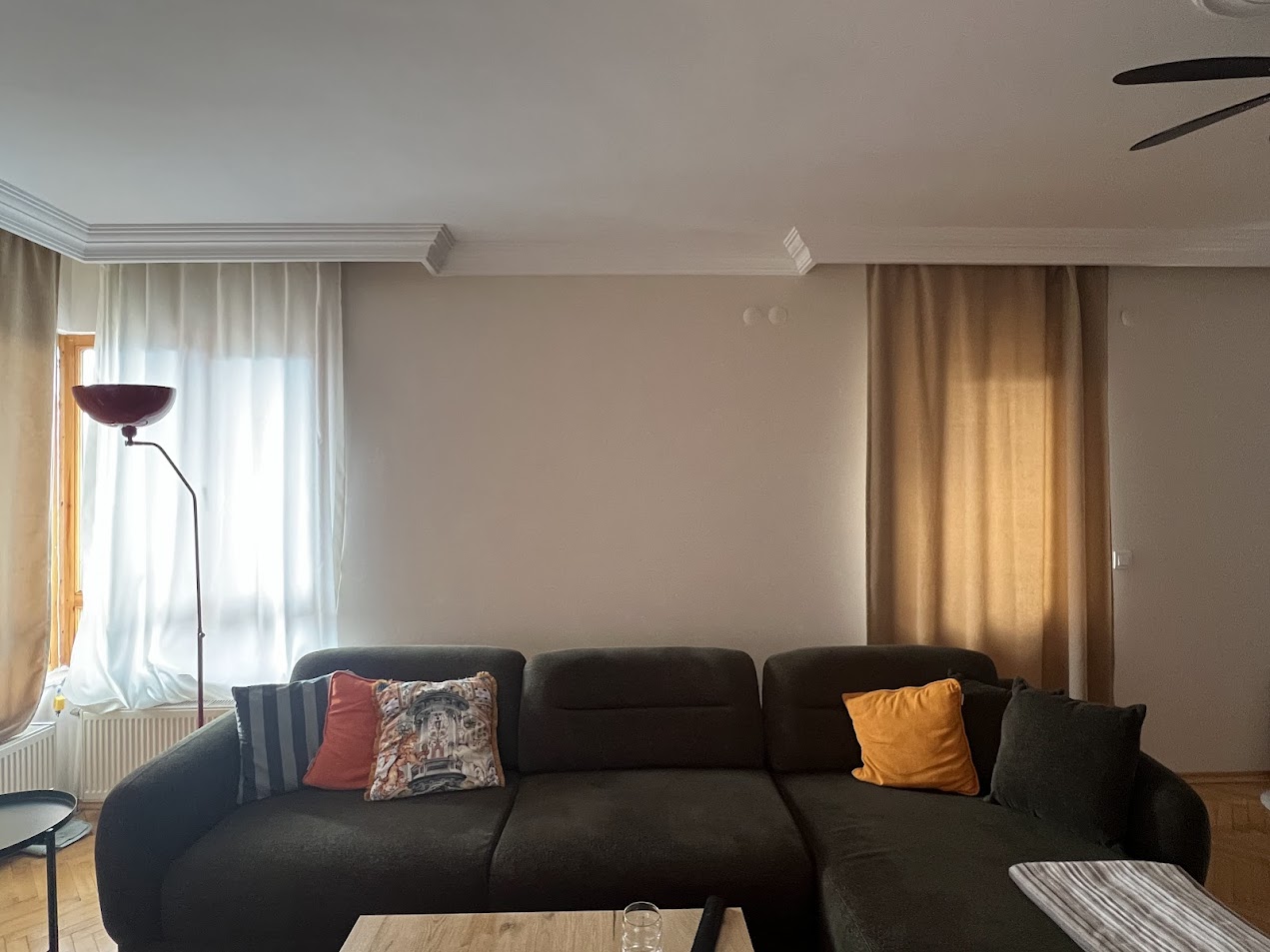
A piece does not have to fill a wall, but a single work covering less than half its width usually looks insufficient.
A practical threshold: for one piece on an empty wall, aim to cover at least 50 per cent of the wall's width. Below that, either go larger or add a second piece. We gathered alternative approaches in the empty wall article.
Four sizing mistakes people keep making#
These come round constantly:
- Buying too small a rug. Choosing a small rug to make a room feel bigger does the opposite; the room looks fragmented
- Hanging a small picture in the middle of a wall. The surrounding emptiness only makes it look smaller
- Hanging too high. A piece above eye level loses its connection to the room
- Calculating on paper without testing in the space. The easiest of these to avoid
The cheapest way to test#
Before ordering, do a paper tape test.
For a rug: mark your chosen dimensions on the floor with masking tape, leave the furniture where it is, and live with it for a few days. Seeing where your feet land tells you far more than a number.
For a picture: cut newspaper or wrapping paper to the same size and tape it to the wall. Test the height the same way. Five minutes of this removes almost all of the risk.
When a custom size is needed#
If none of the standard sizes fit your space, a commission starts to make sense. In custom work you set the dimensions, and since price is calculated per square metre, in-between sizes carry no extra cost, we explained the pricing in detail.
If you are unsure about size, send a photo of the space. We can work out the size and technique together through the custom order page; we also described how the process runs separately.
Dimensions for finished pieces are listed on each work's page in the gallery.
Frequently Asked Questions
What size rug for a living room?
It depends on the seating group. In a mid-size room with a three-seater and an armchair, 120x180 or 140x200 cm is the most common choice. Small rooms suit 100x150 and large rooms 160x230 and above.
Does the rug need to go under the sofa?
Not necessarily, but the most balanced solution is having the front legs on the rug. In large rooms placing all the furniture on it feels more generous; in small rooms the rug can define just the central area under the coffee table.
What size picture goes above a sofa?
The general ratio is about two thirds the width of the furniture. For a 180 cm sofa that is around 120 cm; for a 240 cm sofa around 160 cm, or two 70x100 pieces side by side.
How high should a picture be hung?
The centre should sit 145-150 cm from the floor, which is average eye level and the standard used in galleries. Above furniture, keep the bottom edge 20-25 cm higher than the furniture.
How can I test a size before ordering?
The paper tape test is the most practical. For a rug, mark the dimensions on the floor with masking tape and live with it for a few days; for a picture, cut paper to size and tape it to the wall. Five minutes of this removes almost all of the risk.