Decor
Wall Decor for Offices and Home Offices
Separate advice for meeting rooms, reception areas, open plan floors and the home office, plus echo, video call backgrounds and panels in brand colours.
Updated:
An office wall differs from a home wall in two ways: the person looking does not know you, and the time they spend looking is fixed. Someone waiting in reception looks at that wall for four to six minutes. Someone in a meeting room looks at the same wall for two hours. Those two situations do not want the same piece. Below are measurements space by space, then the two things people actually argue about in offices: echo and the camera.
The meeting room#
First rule, leave the wall behind the screen empty. Whichever wall carries the projector or the television, artwork there competes with it and both lose.
The best surface is the wall facing the long side of the table. For an eight seat, 240 cm table, a single piece 140 to 180 cm wide works on the opposite wall, or two 60x80 cm pieces with 8 to 10 cm between them.
Height changes here. Everyone is seated, so drop the centre of the work from the usual 152 cm to 140 or 145 cm. A hang that looks right while you stand sits too high once people sit down.
Keep the palette calm. Across a two hour meeting a highly saturated, high contrast piece wears people out. This is the room for work with texture and a quiet colour range.
Reception and waiting areas#
This is where first impressions are made, and it has one honest measure: the visitor sits, looks at their phone, then lifts their head. What do they see when they do?
The wall behind the reception desk is the natural home for brand identity. For a 180 cm desk, a piece 110 to 130 cm wide feels balanced. Since desks run 105 to 110 cm high, keep the bottom edge 30 cm above the desktop or whoever is standing there will block the work.
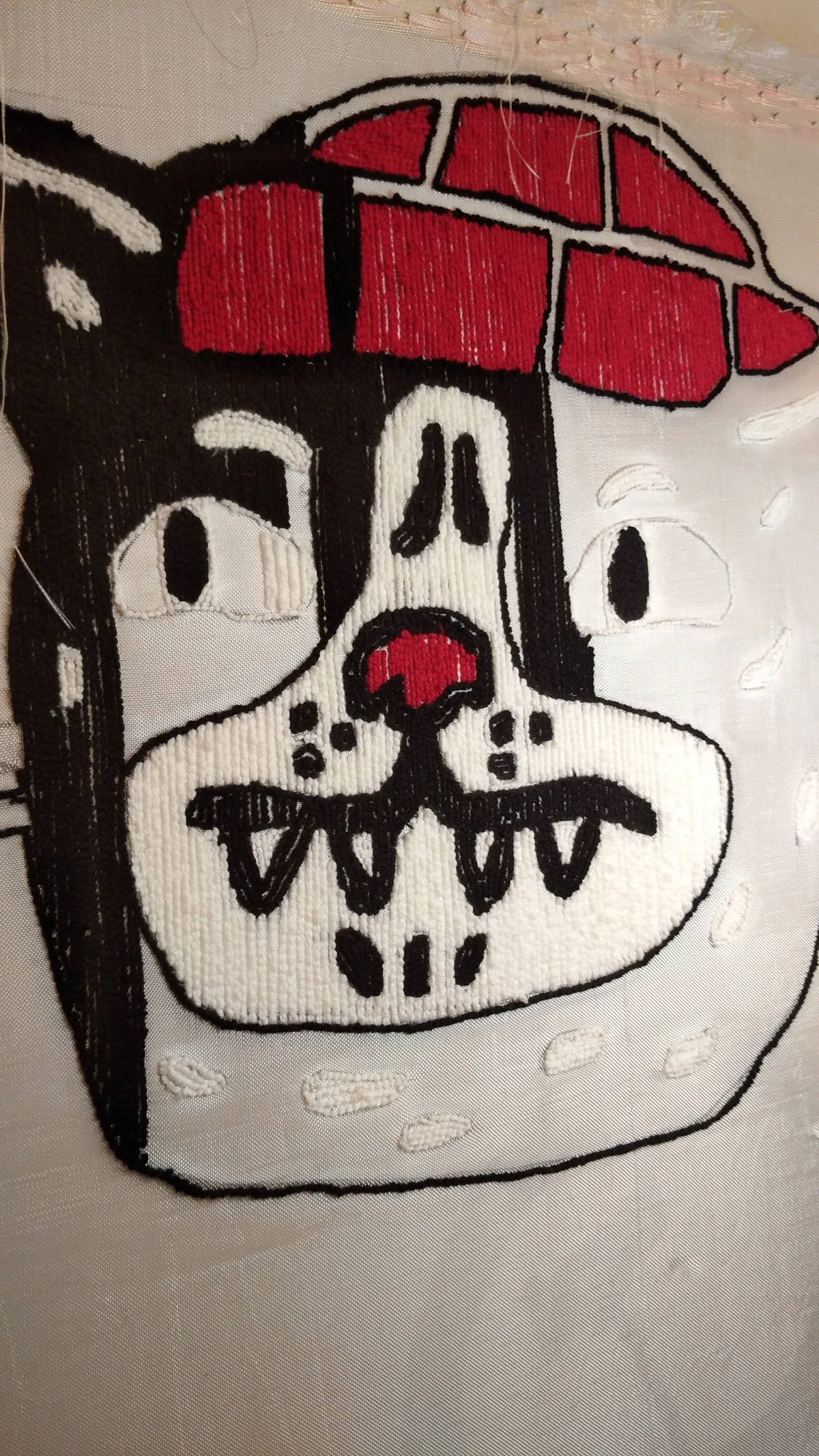
Textured surfaces have a side effect: people genuinely touch them. Within a year, the lower edge of a tufted panel in a waiting area will have been handled. Treat that as interest rather than a problem, and know how to clean it.
Open plan floors#
Open plan means few walls and many columns. Column faces usually run 60 to 80 cm wide, which no landscape format will fit. Go narrow and vertical instead: 40x120 cm or 50x100 cm sits correctly on a column.
Factor screens into the colour choice. For a team looking at monitors all day, a highly saturated orange or red surface inside their direct field of view becomes tiring. Move saturated colour to the break area, the corridor or the kitchen wall, and keep the work zone muted.
Large empty walls are easier to solve with a rhythm of pieces than with one enormous work, and the composition approaches in how to fill an empty wall apply here too.
The home office#
A home office has two walls and they do different jobs.
The wall opposite the desk is the one you look at while working. Put something calm and low in contrast there. It is the surface your eyes land on when they leave the screen, so it needs to rest them.
The wall behind the desk is the camera wall, the one that concerns whoever is looking at you. For a 120 cm desk, a piece 70 to 90 cm wide works, with its bottom edge 25 to 30 cm above the desktop.
Echo: how much does a soft surface really help?#
There are a lot of inflated promises around this, so let me be plain.
A hard room looks like this: plastered or concrete walls, glass partitions, laminate floor, a wooden table. Sound returns off every surface, speech intelligibility drops, and people in meetings raise their voices without noticing.
A pile textile surface absorbs part of the mid and high frequencies. Depending on pile height and the air gap behind it, the absorption coefficient sits roughly between 0.15 and 0.40. At bass frequencies the effect is close to nothing, so do not expect a thick rug to cut a low rumble.
A concrete example: in a 20 m² hard surfaced meeting room, one 120x180 cm tufted panel (2.16 m²) produces a noticeable softening compared to the bare wall. Speech rings less. It does not solve the room acoustically; a real fix treats several surfaces together, meaning rug, curtain, upholstered seating and, if needed, a ceiling panel.
Two practical details:
- Hang the panel 2 to 3 cm off the wall rather than flush against it. The air gap behind measurably increases absorption.
- Choose one of two facing hard walls. Flutter echo, that short metallic ring, forms mostly between parallel surfaces.
A panel is not a substitute for an acoustic panel. Then again, an acoustic panel is not much to look at. For an office that wants both at once, a textured piece is a reasonable middle path.
Video call backgrounds#
What looks good on camera and what looks good to the eye are not always the same thing.
The most common mistake is fine pattern. A camera sensor shimmers on repeating patterns close to its pixel pitch, so a surface with 2 to 3 mm stripes ripples on screen and produces moiré. Choose large forms and few of them.
Depth is the second issue. Keep the piece 1 to 1.5 meters behind you. At that distance the background softens slightly and stops competing with your face. Work hung on the wall your back is against looks stuck to you on camera.
In the frame, do not centre the piece directly behind your head; let it sit toward one shoulder. Its bottom edge should stay above shoulder height from where you sit.
On colour, oranges and reds close to your skin tone confuse the camera's white balance, so a neutral or slightly cool background is safer. Glazed frames reflect the ceiling light straight back and show up as a white patch. Canvas and tufted surfaces carry no glass, so the problem does not arise.
Brand colours and logos in yarn#
The request that comes up most on the corporate side is a logo or a brand colour worked into a panel. Both are possible, with two technical limits worth knowing up front.
Colour is matched from a yarn card, not printed, so it will not land exactly the way ink does. Given a Pantone or RAL code, what actually happens is that the two or three closest tones on the card get sampled and approved. If the brand colour is an unusual in between shade, you get the nearest match rather than the exact one.
The limit on detail comes from the yarn itself. Because of loop spacing and yarn thickness, detail finer than about 10 mm does not come out cleanly. Fine serif typefaces, thin line emblems and small slogan text simply do not read in tufting. Letter strokes need to be at least 1.5 to 2 cm thick, which pushes most wordmarks to 120 cm wide and beyond. The production route is set out step by step in rugs made to a name or a logo, and sizes, palettes and dates can be settled through the custom order page, where work starts with a 30 percent deposit and takes around 21 days.
Before committing to an office wall, run the cheapest test there is: mark the size you have chosen on the wall with masking tape and leave it for a day. If that rectangle looks small the next morning, the artwork will look small too.
Frequently Asked Questions
Does a tufted wall panel reduce office echo?
A pile surface absorbs some of the mid and high frequencies and does very little at bass. In a 20 m² hard surfaced room a 120x180 cm panel gives a noticeable softening without solving the room on its own. Hanging it 2 to 3 cm off the wall increases absorption.
What works well behind you on a video call?
Large forms, and not many of them. Repeating patterns with 2 to 3 mm spacing shimmer on camera. Keep the piece 1 to 1.5 meters behind you and off to one shoulder rather than centred behind your head.
How high should art hang in a meeting room?
Because everyone is seated, drop the centre from the usual 152 cm to 140 or 145 cm. In a room with a 240 cm table, a single piece 140 to 180 cm wide balances the opposite wall.
Can a company logo be tufted into a panel?
Yes, though detail finer than about 10 mm will not come out cleanly. Letter strokes need to be at least 1.5 to 2 cm, which pushes most wordmarks to 120 cm wide or more. Colour is matched to the nearest tone on the yarn card rather than reproduced exactly.