Painting Techniques
What Is a Linocut? How It Is Made and How It Differs from Etching
What a linocut is and how it is made: materials, carving and printing, multi-colour methods and the difference from etching. Is a linocut an original work?
Updated:
A linocut is a relief print: a design is carved into a sheet of linoleum, ink is rolled over the surface, and the block is printed onto paper. The carved-away areas stay white; the uncarved surface carries the ink. Each impression is inked and printed by hand, and prints pulled from the artist's own block, signed and numbered, count as original works.
The technique looks simple, and it is. But the sharp, high-contrast language you see in the result comes from hours spent with a carving tool. Below I cover where lino came from, how it is done, the two routes to colour, and how it differs from etching.
Where did linocut come from?#
Linoleum was first made in the second half of the nineteenth century as a floor covering, pressed from linseed oil, resin and cork dust onto a jute backing. Artists began using it as a printing block at the start of the twentieth century. Softer than wood and without grain, it could be cut equally easily in any direction.
The German Expressionists, especially the artists of the Die Brücke group, took it up as an extension of woodcut. Picasso took lino somewhere else entirely in the late 1950s, working in Vallauris with the master printer Hidalgo Arnéra: he developed the reduction method, cutting a single block again after each colour to produce multi-colour prints. (Sources: Wikipedia, Linocut and Museu Picasso Barcelona.)
For a long time it was seen as the "easy" technique of school art rooms. That reputation hid what lino is really good at: hard black and white contrast and the mark left by the cut.
Materials#
- Lino block. Artists' lino for printing is usually around 3 mm thick. The grey, harder kind holds a fine line well; softer types are easier to cut but less crisp in detail.
- Carving tools. A V gouge for lines and contours, a U gouge for clearing areas. One V and two U gouges of different widths are enough to start.
- Printing ink. Water-based ink cleans up easily but dries fast; oil-based ink stays open longer and gives a denser black.
- Brayer (rubber roller). To spread ink thinly and evenly over the block.
- Inking slab. A sheet of glass or flat acrylic.
- Paper. Thin, absorbent papers (such as rice paper) print easily by hand; heavy printmaking papers need a press.
- Baren or a wooden spoon. To press the back of the paper if you have no press.
- Bench hook. A simple wooden jig that holds the block still; a slipping hand is the most common cause of injury when carving.
Step by step#
Drawing and reversing
A print comes out as a mirror image. A face looking right on the block looks left on the paper. Any lettering has to be written backwards. Preparing the drawing on paper and transferring it reversed with carbon paper makes this easier.
Deciding what to cut
The logic of relief printing: everything you cut stays white. So you do not cut the line you want to print black; you cut around it. This reversed thinking is what beginners struggle with most. Blackening the block with ink or a marker and watching the white open up as you carve helps.
Carving
Always push the tool away from yourself and away from your other hand. Lino stiffens in the cold; in winter, leaving the block on a warm surface for a few minutes before carving makes the tool move more easily. When clearing large areas, ridges left below the surface can pick up ink, so cleared areas need to be cut deep enough.
Inking
Put a little ink on the slab and roll it in every direction until you have a thin film. Ink at the right consistency leaves a fine orange-peel texture on the roller and makes a soft hissing sound. Then apply several thin passes to the block. Ink rolled on thickly in one go fills the fine lines.
Printing
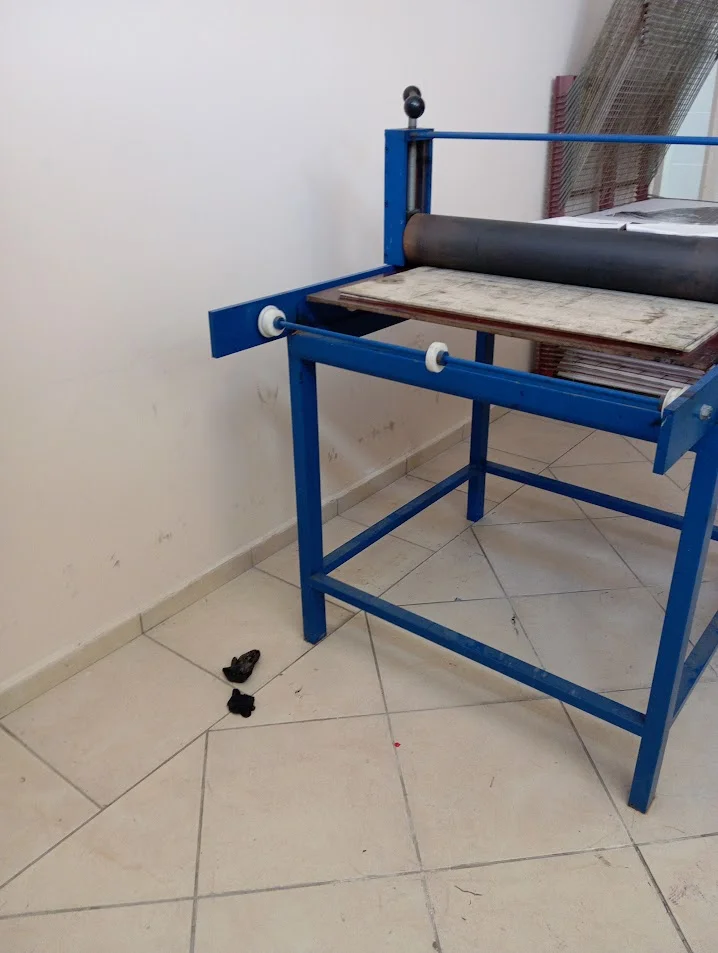
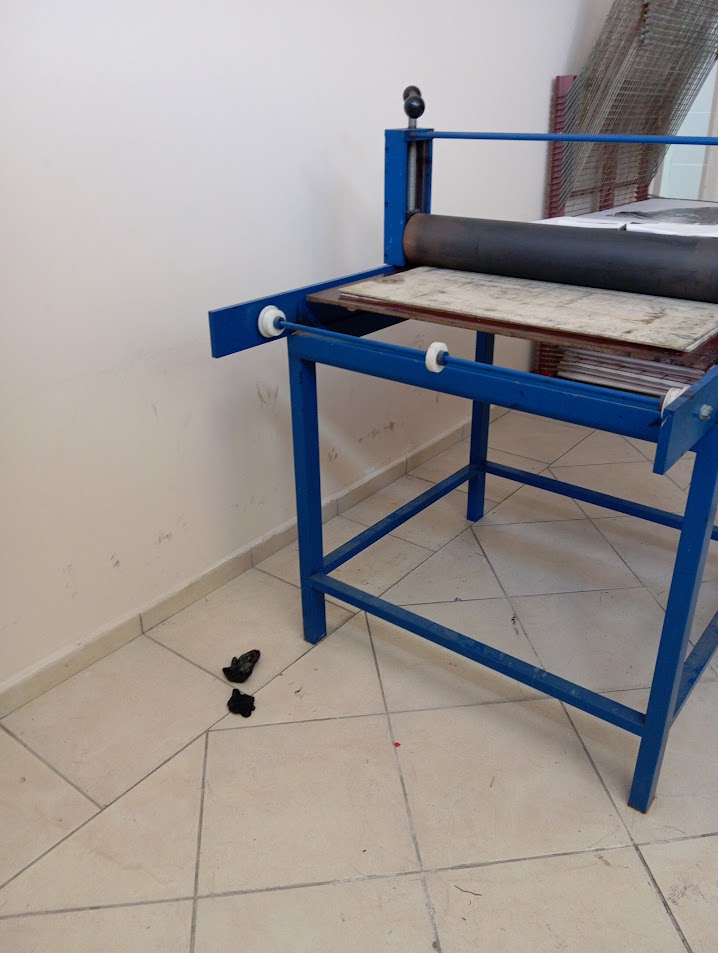
Lay the paper carefully on the block and, without letting it slide, press with a baren or the back of a spoon in small circles. With a press, the pressure is kept much lower than for etching. You can lift a corner of the paper to check the density; if it is not enough, lay it back in exactly the same place and continue.
Drying and signing
Prints are dried flat or hung. Water-based ink can dry in an hour or two, oil-based ink can take several days. Signature and number go in pencil in the white margin below the image.
Colour linocut: reduction and multiple blocks#
There are two ways to print lino in colour.
In the multi-block method, a separate block is cut for each colour, and the blocks are printed in turn onto the same sheet. The advantage is flexibility: a damaged block can be recut, and the edition can be printed later. The difficulty is registration: every block has to land on the paper in exactly the same place, to the millimetre. A registration jig that fixes the position of paper and block is used for this.
In the reduction method there is only one block. First, everything that should not take the lightest colour is cut away, and the whole edition is printed in that colour. Then the areas that should not take the next colour are cut from the same block, and the same sheets are printed again. The block shrinks a little with every round. There is no going back: when the last colour is printed, most of the block has been cut away and the print cannot be pulled again. The edition size is fixed at the very start, with the first colour.
Reduction leaves little margin for error, but the result is a layered surface built from closely related tones. Picasso's colour linocuts from the late 1950s are the best known examples of the method.
How does a linocut differ from an etching?#
Both are original printmaking techniques done by hand, but the ink sits in exactly the opposite place on the plate.
- Where the ink is: in a linocut on the raised, uncut surface; in an etching in the recess, inside the line that was scratched or bitten with acid.
- The plate: soft linoleum for lino; usually a metal such as copper or zinc for etching.
- The line: lino gives broad areas and sharp, high-contrast edges; etching can give hair-fine lines and soft tonal transitions.
- Pressure and paper: lino can be printed on dry paper at low pressure, even by hand; etching is printed on dampened paper in a high-pressure press.
- Plate mark: in an etching the edge of the metal plate leaves an embossed border on the paper; in a linocut there is usually none, or only a faint one.
- Durability: a metal plate survives long editions; on a lino block fine lines can begin to thicken after many impressions.
I went through the stages of etching in what an etching is.
Is a linocut an original work? Edition and signature#
Yes, on these conditions: the block came from the artist's own hand, each impression was inked and printed by hand, and the prints are signed and numbered. Then a linocut is not a reproduction but an original print.
Numbering is done in pencil. In the white margin below the image, the edition number goes on the left (for example 7/20, the seventh of an edition of twenty), the title in the centre, signature and year on the right. The first number is not a ranking of quality, only the order of printing. Impressions the artist keeps outside the edition are marked A.P. (artist's proof).
There is an important distinction here: a print reproduced from a photograph of a painting is not an original work, even if the artist signs it. I explained the difference in original work or print, and where signatures and details sit in certificates of authenticity.
When framing a linocut, use a mount so the paper does not touch the glass; mounts and frames are covered in choosing a frame.
From the studio: Gourds and Güç#
There are two linocuts in the gallery, and they show the two ends of the technique.
Gourds (Kabaklar) is a multi-colour linocut on paper, 50x70 cm. The sharp marks of the cut turn gourd and leaf shapes into a rhythmic pattern between two layers of blue. Each hand-printed impression carrying its own marks is part of the technique's character: two prints from the same block differ slightly in ink density and edges. At the time of publication (27 October 2026) it was priced at 2,000 TL and available.
Güç (Power) is a black and white linocut, 100x70 cm. It reinterprets an architectural structure through perspective, rhythm and linear texture; high-contrast black and white areas bring out the geometry and volume of the building. A good example of why black and white lino is such a strong language. It is not currently for sale.
If you would like to know the edition and signature details of either work, ask on the work's page or through the contact page.
If you are thinking of prints as a gift, I explained why they make a good choice in Teachers' Day gifts. Other paintings and prints are on the painting page.
Frequently Asked Questions
How many prints can be taken from a lino block?
There is no fixed number; it depends on how hard the block is, how fine the lines are and how much pressure is used. Lino is softer than metal, so fine lines can start to thicken after many impressions, which is why editions are usually kept limited. In the reduction method the block is recut for each colour, so the edition is fixed at the start and no further prints can be taken.
Can a linocut be framed like a painting?
Yes, but as a work on paper it needs glazing and an acid-free mount. The mount keeps the paper from touching the glass. Keep it away from walls in direct sun as well, since paper and ink are affected by light over time.
What is the difference between linocut and woodcut?
Both are relief prints, with ink on the uncut surface. The difference is the material: wood has a grain, the tool behaves differently with and against it, and the grain texture can show in the print. Lino has no grain, is softer, cuts equally in every direction and gives flatter, more even blacks.
Can you make linocuts at home?
Yes. A press is not essential; you can print by hand on thin paper with a baren or a wooden spoon. A lino block, one V and two U gouges, water-based ink, a brayer and a glass slab are enough to start. Use a bench hook to hold the block and always cut away from your hands.