Inspiration
What Is Watercolor? Pigment, Paper and the Logic of Transparency
Why watercolor is transparent, how tube and pan paint differ, what paper weight and texture change, and what to check before buying a watercolor piece.
Updated:
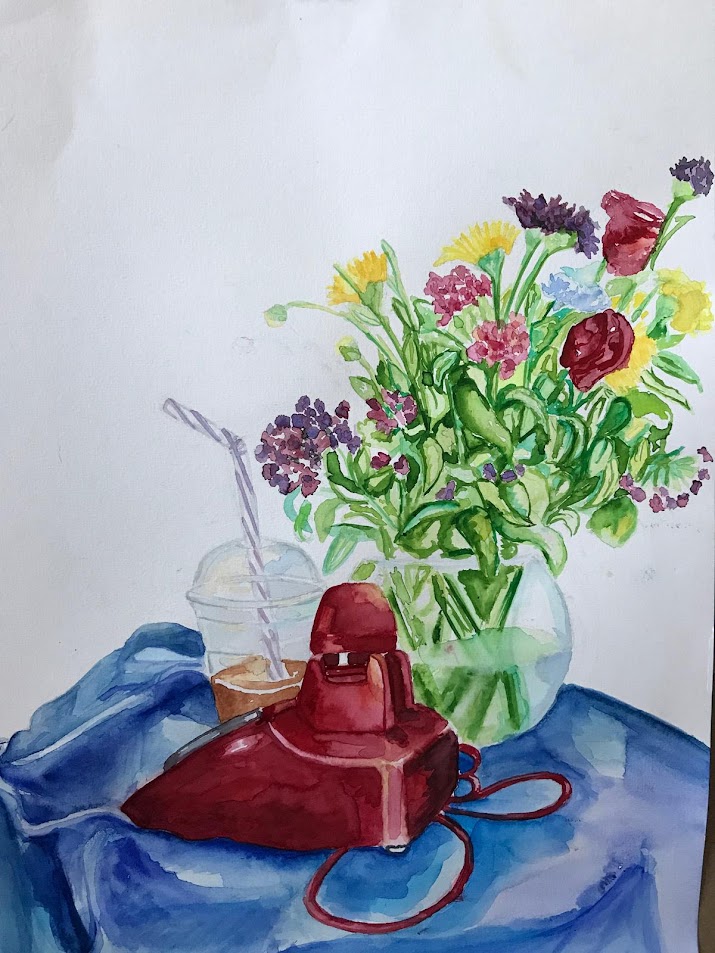
Watercolor is paint made by binding pigment with gum arabic, thinning it with water and laying it on paper. What separates it from other paints is that it does not cover. Oil and acrylic hide the layer underneath; watercolor does not. Light passes through the paint film, hits the white of the paper and comes back out. The brightness in a watercolor belongs to the paper, not to the paint.
What is in the pan#
Two components are enough: the pigment that carries the color and the binder that fixes it to the paper. In watercolor that binder is gum arabic, a resin from the acacia tree. It dries to a transparent film with pigment particles suspended inside it.
Glycerine or honey is added as well. These keep the paint re-soluble after drying and stop it from cracking out of the pan. That is why watercolor can be reworked with water even long after it has dried.
Pigment load is the real difference between student and artist grade paint. Student ranges carry less pigment and make up the volume with filler; on paper they leave a pale, grayish mark. To reach the same saturation you have to lay one coat over another, and every coat wears the paper surface a little more.
Tube or pan#
Pan paint is sold dried. You wet the brush and rub it across the block to release color. It travels well, it does not dry out, and closing the box ends the session. Practical for small studies and for painting outdoors.
Tube paint is a moist paste. You lift far more pigment onto the palette, far faster. If you want to wash the sky of a 30x40 centimeter sheet in one go, rubbing enough color out of a pan takes time, and the tube has a clear advantage there.
There is no inherent quality gap between the two. Same brand, same pigment, two kinds of packaging.
Paper is half the technique#
In watercolor, paper is not a support. It is part of the material.
Weight is your first decision. Paper under 190 gsm buckles when wet and keeps that buckle after drying. A 300 gsm sheet stays flat in most work without being stretched. Sheets around 250 gsm handle moderate water use.
Fibre is the second decision. 100% cotton paper absorbs and holds water, letting you move paint on the surface for longer, and it survives lifting and reworking. Cellulose paper is cheaper but repels water quickly, so transitions turn hard-edged.
The third is texture. Cold press has a medium tooth and is the most common choice; that tooth holds pigment and shows itself in dry brush work. Hot press is smooth and flat, suited to fine detail and crisp lines, though paint slides across it faster. Rough is the coarsest and gives the broken, scattered marks landscape painters use.
Brushes#
The one thing a watercolor brush has to do is hold water. Squirrel hair holds the most, but its tip is soft and gives little control. Sable holds water and keeps a point, which is why it is the traditional choice. Synthetics are cheap and hold less, so you reload more often.
In practice three brushes carry you a long way: a 25 millimeter flat wash brush, a size 10 round and a size 4 round. Adding brushes does not improve a painting. Learning to control water does.
Wet on wet and dry brush#
In wet on wet, the paper is wetted first and paint is dropped onto that wet surface, where it spreads on its own. Edges stay soft, and skies and mist are made this way. The difficulty is timing: as the moisture level drops, the paint stops moving. You usually have a window of about half a minute. Touch the paper when it is half dry and you get a ragged, cauliflower-shaped bloom, and that bloom is permanent.
Dry brush is the opposite. You squeeze the water out and drag stiff paint across the peaks of textured paper; the color never reaches the valleys and leaves a broken, scattered mark. Bark, sea foam and weathered surfaces come out this way.
The skill underneath both is measuring water. Anyone who cannot control how much water sits in the brush cannot predict the result of any technique.
Why it is hard to correct#
In acrylic you can paint over an area that went wrong, and the paint covers it. Watercolor has no covering layer. Pigment sinks into the fiber of the paper and stays there.
Then there is the question of white. In watercolor, white is usually not paint at all, it is the paper left unpainted. So you have to decide where the light falls before the first brush stroke. Masking fluid can protect those areas, but the edges come out hard when it is lifted, and not every paper reacts to it the same way.
Lifting is possible. Softening with a damp brush and blotting with a clean cloth removes part of the color. Staining pigments such as phthalo blue and alizarin crimson sink into the fiber and never come out fully. The paper surface also erodes a little with every attempt, and by the third try it starts to fuzz.
This difficulty is not a flaw in watercolor, it is its character. In a technique with no undo, every brush stroke becomes a decision.
What to check when buying a watercolor#
Watercolor is among the most light-sensitive kinds of painting. If you are buying a piece, look at these:
- Lightfastness. Ask whether the artist worked with pigments rated as lightfast. Fugitive pigments fade visibly within a few years.
- Paper. 100% cotton, acid-free paper does not yellow over time. Acidic paper browns from the edges inward.
- Glazing. A watercolor has to be displayed behind glass or acrylic. UV-filtering glass slows fading.
- Mat board. It should be acid free, and it should keep the painting off the glass. Paint pressed against glass leaves a permanent mark once moisture gets in.
- Where it will hang. A wall in direct sun, the space above a radiator and damp rooms such as bathrooms are all wrong.
Framing and mat decisions are covered in detail in choosing a frame for a painting. If you want to tell an original from a print, original or print goes into that separately.
The studio does not take watercolor commissions; on the painting side I work in acrylic on canvas. How acrylic behaves is covered in what is acrylic paint, and current work is in the gallery.
Frequently Asked Questions
Why is watercolor transparent?
Gum arabic, the binder, dries into a transparent film with the pigment suspended inside it. There is no opaque filler, so light passes through the paint layer and reaches the paper underneath. The brightness you see comes from the white of the sheet, not from the paint.
What paper weight should I use for watercolor?
Paper under 190 gsm buckles when wet and will not flatten out again as it dries. For most work a 300 gsm sheet stays flat without being stretched. Paper made from 100% cotton holds water longer, which makes soft transitions much easier to control.
Is tube or pan watercolor better?
There is no built-in quality gap; the same pigment is sold in two kinds of packaging. Pans are practical for travel and for small studies. When you need to wash a large area in one pass, tubes release more paint faster and have the clear advantage.
What happens if a watercolor is exposed to sunlight?
Pigments with poor lightfastness fade visibly within a few years, and acidic paper yellows inward from the edges. Hang the piece on a wall that gets no direct sun, use UV-filtering glass, and choose an acid-free mat so the painting never touches the glass.
Does Peck Art Studio take watercolor commissions?
No. The studio produces tufted wall panels, tufted floor rugs and acrylic on canvas. Watercolor is covered here as background information, not as something we take commissions for.