Tufting
What Is a Tufting Gun and How Does It Work? Cut Pile, Loop Pile and Needle Depth
How a tufting gun pushes yarn into stretched backing, why cut pile and loop pile are two different machines, and what needle depth actually changes in the finished piece.
Updated:
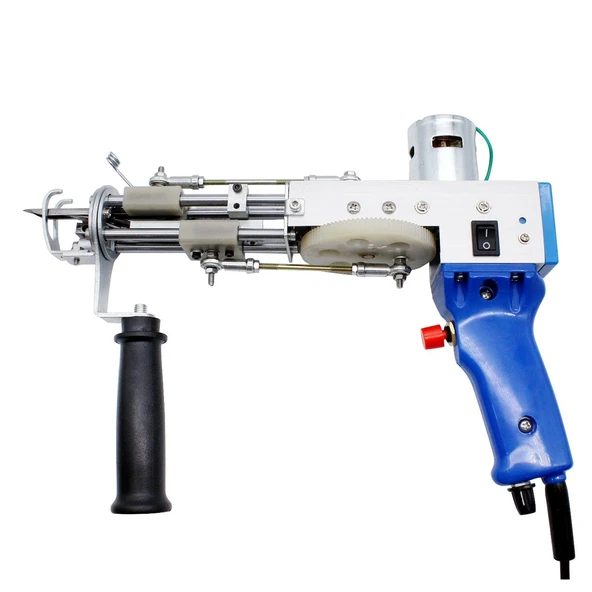
A tufting gun is a handheld motorized tool that pushes yarn through stretched backing fabric and leaves a loop on the other side. It does not tie knots the way a sewing machine does. The yarn is held in place by the weave itself, and what really keeps a rug together is the glue layer applied to the back. Here is what the tool does, why it comes in two versions, and which settings decide the quality of every loop.
What the tool actually does#
There is a small motor inside the body. It drives a shaft, and the shaft pushes a needle back and forth dozens of times per second. Yarn feeds from a cone through the eye of that needle. When you hold the gun square against the fabric and push it forward, the needle pierces the backing and carries the yarn to the other side. On the return stroke the yarn stays there and the next stitch lands beside it.
Two rules matter, and neither one sinks in on day one. The gun has to sit at close to 90 degrees against the fabric; wherever I tilt it, the needle cuts the threads of the backing, the hole widens and the loop will not hold. The second rule is that the tool works by being pushed. On rows where I pull it back, the yarn goes slack, the line skips, and I only notice when I turn the work over.
With the cable attached, most guns weigh between 1.5 and 2.5 kilograms. You hold that weight horizontally for hours. The tiring part of the job is not motor power, it is this.
One thing worth clearing up: no pattern is loaded into this tool. It has no memory, reads no file and follows no line by itself. Industrial tufting machines in carpet factories drive hundreds of needles from a computer. A handheld gun has one needle, and only your hand decides where it goes. I covered the background of the technique in what is tufting.
Cut pile and loop pile are not the same machine#
There are two types of gun, and most models do only one of the two.
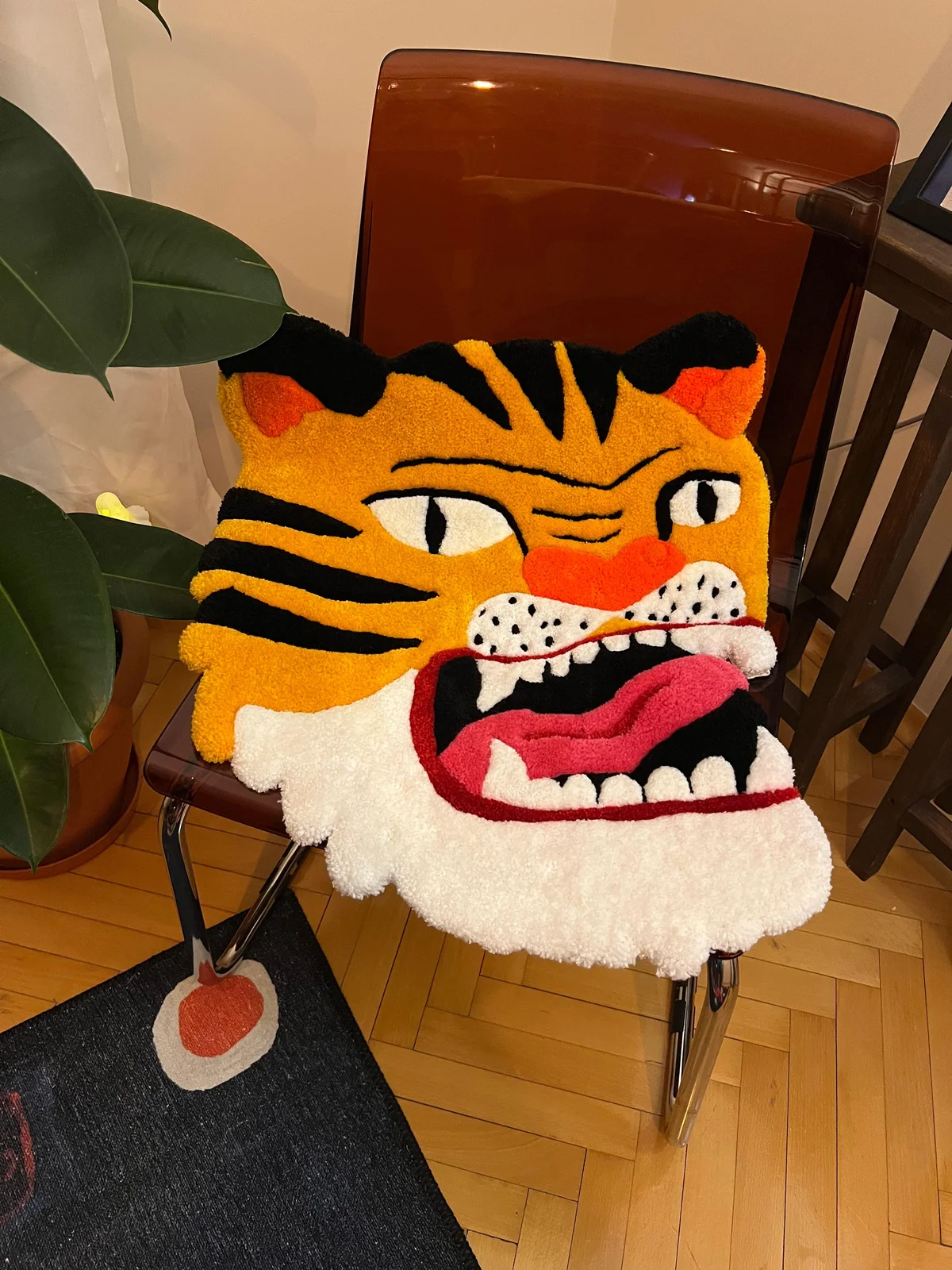
A loop pile gun leaves the yarn as an uncut loop. The surface comes out dense and even, and lines stay crisp. A cut pile gun carries a small blade at the tip; every loop is cut as it forms, and the freed ends build a velvety pile.
In a finished piece that difference shows up like this. With loop pile even a 5 millimeter line stays readable, while in cut pile anything thinner than a centimeter disappears because the cut ends lean sideways. For lettering, fine outlines and sharp geometry I use loop pile. For surfaces where I want a soft color transition, cut pile works better, since the cut ends blend into the neighboring color. There is a texture comparison in cut pile vs loop pile.
Using both in one piece is also possible. On panels where the background is looped and the figure is cut, light bounces differently off the two surfaces, so the design still reads from across the room.
Needle depth and pile height#
Every gun has an adjustment that sets how far the needle travels past the fabric. The range I work in runs from 6 to 22 millimeters. On wall panels, 10 to 13 millimeters usually gives the best result. On floor rugs I keep the pile shorter, because a long pile lies flat underfoot and the spot people step on stays visible for months.
A wrong setting fails in two directions. Too deep and the loops cannot carry their own weight, so the surface ripples. Too shallow and the yarn never seats properly; turn the piece over and you can see the backing weave, and the glue cannot lock that loop in.
I shear the surface with scissors at the end. That takes 1 to 2 millimeters off the top, so the target height has to be set slightly high from the start.
Which fabric it works with#
Two backings are common. Monk's cloth is cotton and carries printed guide lines that help with alignment, but it stretches. Up to about 60x80 centimeters it causes no trouble; on a 120x180 piece the middle starts to sag. For those I use polyester blend tufting cloth instead, which gives far less.
Tension matters more than any setting on the gun. Slap the fabric with your palm and it should sound like a drum. If pressing with a finger sinks more than a centimeter, I restretch the frame. The fabric is held by the pins of carpet gripper strips nailed along the frame.
Over tightening is not the answer either. On pieces I stretched past the limit, the needle sliced through the weave, the holes joined up and that whole area tore. How yarn choice plays into this balance is in types of tufting yarn.
Noise, vibration and studio reality#
A motorized gun is not a quiet tool. Two hours without ear protection and I have a headache. The vibration travels into your hand, and after long sessions my fingertips go numb. The motor heats up too, so every 40 to 45 minutes I stop and rest both the tool and my wrist.
The sound carries into the next room. I do not tuft in the evening; those hours go to drawing designs and to the waiting stages after gluing.
What this means if you are buying the work#
The tool gives you speed, not decisions. Where one color turns into another, how thick an outline runs, which area is cut and which is looped, how many passes a section gets: all of that is settled by hand. When I tuft the same design twice, the two pieces are never identical. Even the direction of the pile differs.
If you are considering a commissioned piece, we make the size and technique decisions together. Production takes roughly 21 days and starts with a 30% deposit; details are on the custom order page.
If you are thinking of starting as a hobby#
Your first rug will be bad. I am writing this to prepare you, not to put you off.
These five things go wrong most often at the beginning:
- The fabric is not tight enough, so loops spring back out.
- The gun is held at an angle, so the backing tears.
- You move too fast, leaving gaps between rows.
- Needle depth is set wrong, so the surface ripples.
- The backing glue goes on thin or uneven, so the edges unravel over time.
Drawing a clean edge line took me several weeks. Traveling in a straight line is easy; realizing that on curves you turn your own body instead of the gun takes longer.
I will not quote figures on materials, because yarn and equipment prices move constantly. On space I can be specific: a 1x1.5 meter frame needs at least 2 square meters of clear floor in front of it, and the short fibers thrown around during shearing create a real cleaning job. I have never met anyone who wanted to do this in the middle of a living room.
Frequently Asked Questions
Does a tufting gun work like a sewing machine?
No. A sewing machine locks two threads together into a knot. A tufting gun pushes a single yarn through stretched fabric and leaves a loop on the far side. What makes that loop permanent is not a knot but the glue coat on the back and the secondary backing pressed onto it.
Can a cut pile gun also do loop pile?
Most models do one job only, since the blade at the tip of a cut pile gun slices every loop as it forms. Machines that offer both modes exist, but switching between them means reworking the setup. Keeping two separate guns in the studio turns out faster in practice.
Is a rug made with a gun still handmade?
No pattern is loaded into the gun; it has no memory and no automatic movement. Where the line travels and where one color gives way to another is decided by the artist's hand. The motor drives the needle, not the composition.
Can a tufting gun be used at home?
Technically yes, but two things get in the way. The noise carries into the next room, and shearing throws short fibers across the whole space. A 1x1.5 meter frame needs at least 2 square meters of clear floor in front of it, so a separate room or a corner you can shut off is more or less required.