Tufting
Tufting Yarns: The Difference Between Wool, Acrylic and Blends
Yarn determines a tufted rug's lifespan, texture and price. How wool and acrylic differ, which ages better in which room, and what to look out for.
Updated:
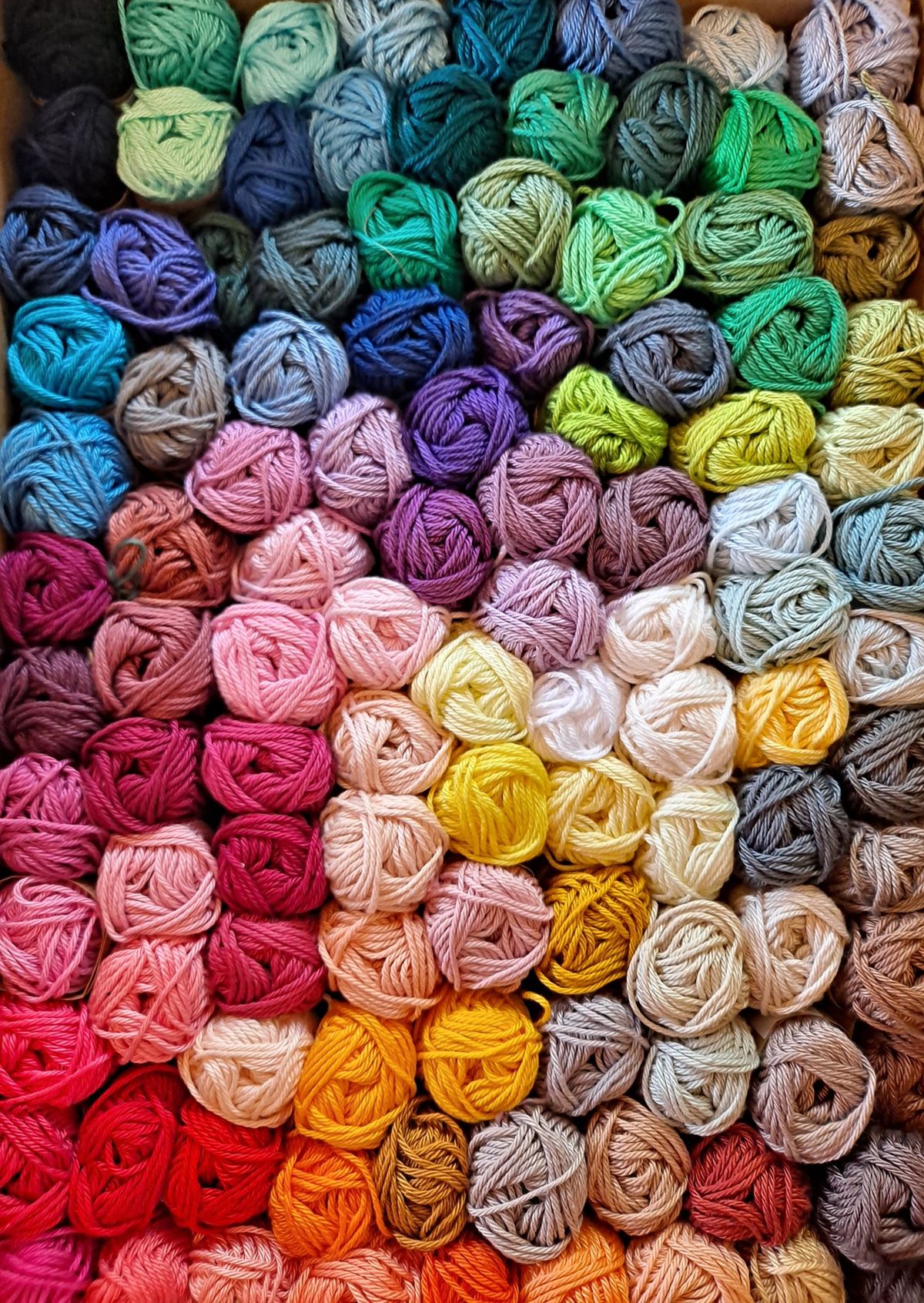
Most of what you see when you look at a tufted rug is yarn. The artist builds the design, but how the surface sits, how many years it lasts, how it behaves underfoot and what it costs are largely down to the yarn.
This article is not for hobbyists buying yarn; it is for someone buying or commissioning a piece. So the question is not "which yarn should I buy" but "what is in my piece and what does that mean".
Two main routes: wool and acrylic#
The vast majority of tufting yarn is one of these or a blend of them.
Wool is a natural fibre. It gives a matte surface, sits heavy and absorbs light softly. Its most important quality is how it ages underfoot: crushed, it largely recovers, because the fibre is naturally crimped and elastic. It also holds dirt and water at the surface for a while, which gives you a chance to deal with spills.
Acrylic is a synthetic fibre. It offers a very wide colour range and the colours come out saturated. It resists fading, in a sunlit room it holds its colour longer than wool. It is lighter and noticeably more affordable.
In short: wool leads on touch and ageing, acrylic on colour and cost.
Blends#
In practice, blends are the most common solution. They combine wool's recovery with acrylic's colour range and cost.
As the ratio shifts, so does the character: blends high in wool are more matte and heavier, those high in acrylic are brighter and lighter.
For most domestic use a blend or good-quality acrylic is more than sufficient. Where wool makes a clear difference is on heavily used floors.
Speciality and metallic yarns#
Metallic or differently textured yarns are used as accents on a surface.
There is one rule: never across the whole surface. Metallic yarn reflects light harshly and tires the eye over a large area; its durability also falls short of standard yarn. In small areas, to lift a detail, it is the right tool.
At Peck Art Studio the premium or metallic yarn option is offered at a fixed 1,200 TL and applies to tufted work only.
Yarn thickness and detail#
This is the most important technical point.
On a tufted surface the smallest unit is the thickness of the yarn. So the yarn directly determines what detail can be carried. Finer yarn holds more detail but takes far longer to fill the same area; thicker yarn moves faster but coarsens the forms.
Which is why size and detail cannot be decided independently of yarn. When working a portrait from a photograph, the reason to go large is exactly this, yarn thickness is fixed, so detail is bought with size.
Which yarn for which room#
A practical pairing:
- Living room, under the seating group: blend or wool. Heavy use, so recovery matters
- Bedroom: little difference; acrylic is fine, and I recommend cut pile for bare feet
- Entrance and hallway: durability first. A blend and a loop pile surface
- Children's room: acrylic. Easy to clean, bright colour, affordable
- Wall panel: no foot traffic, so purely aesthetic. Acrylic if colour matters
- Sunlit room: acrylic. Fade resistance is decisive here
Lifespan and upkeep#
Both last a long time when looked after, but they behave differently.
Wool does not exactly love damp but tolerates it; left in a damp environment for long, however, it can develop an odour. It wants a well-ventilated space.
Acrylic is more indifferent to damp. In exchange it is less heat-tolerant than wool; beside a radiator or in a direct flow of warm air the surface can harden over time.
The basic rules are the same for both: dust regularly, deal with spills promptly, keep it out of direct sun, never use chemical cleaners. We gathered the whole care routine separately.
Backing matters as much as yarn#
Most people ask about yarn and skip this, yet weak backing is the most common reason a tufted rug fails early.
When tufting finishes the loops are attached to nothing; what holds them is the adhesive applied to the reverse and the backing cloth laid over it. If the adhesive is insufficient, or the piece came off the frame before it cured, the surface starts shedding loops within a few years.
So when buying a piece it is worth asking about the backing alongside the yarn. We described the production steps, including how and when the backing is applied, separately.
Does yarn affect the price#
Not as a per-square-metre difference, price comes from technique, size and detail density. We explained the pricing in detail.
The premium or metallic yarn option is added as a fixed extra. Standard yarn quality is the same on every piece: we do not cut materials to lower a price; if needed, the size or detail tier is adjusted instead.
What to ask when ordering#
If you are deciding for your own piece, all you need to tell me is: where it will live, and whether it will be walked on.
We work out the rest from there. "By the entrance, a busy spot" points to a blend and loop pile; "on the wall, on the bright side of the living room" points to fade-resistant acrylic.
Choose size and technique on the custom order page and send a photo of the space. For the wider picture, what tufting is gives the general frame.
Frequently Asked Questions
Is wool or acrylic better for a tufted rug?
It depends. Wool ages better underfoot, recovers when crushed and gives a matte, heavy surface. Acrylic has a wider colour range, resists fading, is lighter and more affordable. For most domestic use a blend or good acrylic is more than enough.
Which yarn suits a sunlit room?
Acrylic. It resists fading better than wool, so it holds colour longer in rooms with direct light. That said, no yarn withstands direct sun indefinitely; where possible, hang the piece on a wall that avoids it.
Can metallic yarn be used across a whole rug?
It is not. Metallic yarn reflects light harshly and tires the eye over a large area, and its durability falls short of standard yarn. In small areas, to lift a detail, it is the right tool.
How does yarn thickness affect detail?
On a tufted surface the smallest unit is the yarn's thickness, so the yarn directly determines what detail can be carried. Finer yarn holds more detail but takes much longer to fill the same area. Since thickness is fixed, detail is bought with size — which is why portraits are made large.
What most often causes a rug to fail early?
Not the yarn but weak backing. When tufting finishes the loops are attached to nothing; what holds them is the adhesive on the reverse and the backing cloth. If the adhesive is insufficient, or the piece came off the frame before curing, the surface starts shedding loops within a few years.