Decor
Turning a Photograph into a Tufted Rug: Which Photos Actually Work
Not every photograph becomes a good tufted rug. Light, sharpness, background and the number of figures decide the outcome. Here is what the good ones have in common.
Updated:
"Can you make a rug from this photo?" is the question we get most. The short answer: from most photos yes, but not all of them to the same standard. The difference is not whether the photograph is beautiful, it is what a tufted surface can carry. This article sets out what the photographs that work well have in common, and which images will fight you from the start.
The point is not to put you off. Quite the opposite: choosing the right photograph is the cheapest way to get a far better piece for the same budget.
Tufting's natural limit: yarn thickness#
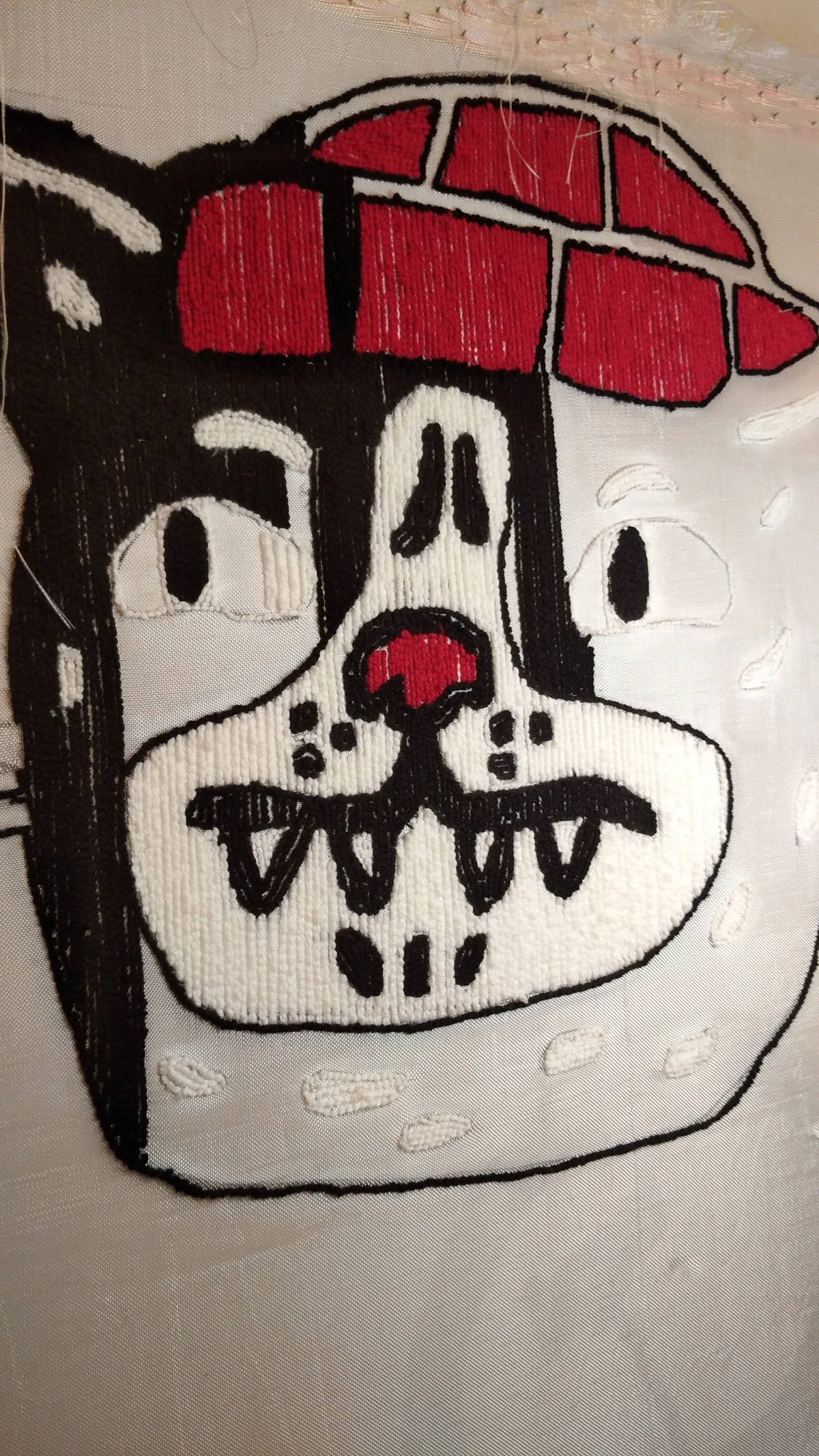
Paint can go as fine as the tip of a brush. Tufting cannot. On a tufted surface the smallest unit is the thickness of the yarn itself. That means the fine detail your eye is used to (an eyelash, small lettering, a distant leaf) cannot be transferred to the surface.
This is not a shortcoming; it is the character of the technique. Tufted pieces are not made to be admired from ten centimetres away but from three or four metres. Strong forms that read at distance, the softness of yarn texture and the depth of colour fields are where this technique wins.
So a good reference photo is not the one with the most detail. It is the one that is still itself after being simplified.
Five things good reference photos share#
Looking back at the commissions that ran smoothly, the same five things appear every time:
- Sharp and high resolution. Taken on a phone is fine; blurry or heavily compressed is not
- One strong subject. A face, an animal, a building, a form. Crowded compositions disappear at one square metre
- An uncluttered background. A plain wall, sky, open ground. Furniture and shelving behind the subject muddy the design
- A clear direction of light. Light from one side gives a face or a form volume. Flat flash light flattens everything
- Colours that separate. If the subject separates from the background in the photo, it will separate on the surface
A photograph that hits three of these five is already a good starting point.
Which photographs are difficult#
These are not impossible, they simply need more interpretation, and the result moves further from the original:
- Group photographs. Three or more faces blur together on a single surface
- Screenshots and images saved from social media. Compression has already eaten the detail
- Very dark or very low-contrast frames. If there is no tonal difference, there will be none in the yarn either
- Night shots under artificial light with shifted colours
- Images containing fine text. A single name works, a sentence does not
If the only photo you have is one of these, send it anyway. We can often rescue it by recropping or focusing on a single subject.
The three most common requests#
The same three subjects come round again and again in commissions:
Pet portraits are the most requested, and they work well. Animals are usually photographed alone, against plain ground, with a clear silhouette. Fur texture and yarn texture suit each other enormously.
Human portraits are more delicate. A face is the thing people know best; a small shift in proportion is noticed immediately. That is why we recommend going large on portraits, below 60x60 a face struggles.
Logos and names are the easiest. A vector logo is already made of simplified forms and translates directly into tufting. These are what we make most for offices and children's rooms.
How size and detail relate#
The two cannot be considered separately. The same photograph gets lost on a 40x40 panel and breathes comfortably at 80x80. The rule is simple: the more detailed the photograph, the larger the piece needs to be.
A practical threshold: for anything containing a human face, at least 60x60 cm, preferably 70x70. Below that the distance between eyes, nose and mouth approaches the thickness of the yarn and the likeness disappears.
Going larger raises the price, of course; we explained how the price is calculated per square metre in a separate article.
How to send your photograph#
On the custom order page, after choosing size and technique, you can upload up to three images from the same screen. These do not go into the site's general upload folder; they are never published at a public address and only we see them. They are your own photographs, so we built that separation deliberately.
Where you can, also include:
- A photo of the wall or floor where the piece will live
- An example image if you have a colour palette in mind
- A short note about any detail you cannot do without
Those three noticeably raise the odds of landing in the right place on the first attempt.
When you hear back#
We review the image and tell you which detail tier fits, what size we recommend and the final price. If the photograph is going to be difficult, we say so up front, agreeing to something and leaving you stranded helps nobody.
The tracking code issued with your request lets you follow the process whenever you like and keep the conversation going from the same screen.
Where to go next#
We gathered the whole commission process (size, technique, price, delivery) in the complete guide. If you are curious how tufting is actually produced, we walked through the steps in the studio too.
If you are unsure whether your photograph will work, the practical move is to send it. I will look and give you an honest answer: will this make a good piece, and if not, which crop or which size would rescue it.
A quick photo check before you send it#
Reduce the reference to about 25 percent on your phone. If the main face, animal silhouette or lettering remains clear, it is a sound starting point for a tufting draft. If eyelashes, individual hairs and small background objects disappear at that scale, the image needs simplification.
You do not have to rely on one photograph. The custom order form accepts up to three images. One can be the main reference, another a different angle, and the last a view of the wall where the work will hang. The studio chooses a workable crop during the draft stage; your photograph is not transferred to cloth unchanged.
If you would rather choose a finished composition, browse the available tufted works. You can judge the completed surface and actual scale before deciding. Shipping and return coverage is set out on the delivery and returns page.
Instead of guessing whether the image is suitable, send the references through the secure form. The initial review will clarify which crop and dimensions can work.
Frequently Asked Questions
Can a tufted rug be made from a photograph?
Yes. Sharp, well-lit photographs with a single subject and an uncluttered background give the best results. Yarn thickness sets a natural limit on detail, so the design is simplified somewhat , which produces a piece that reads far more strongly from a distance.
What is the smallest recommended size for a portrait?
For anything containing a human face we recommend at least 60x60 cm, preferably 70x70. Below that the distance between eyes, nose and mouth approaches the yarn thickness and the likeness is lost.
Can you work from a group photograph?
It is difficult. Three or more faces blur together on a single surface. We usually suggest cropping in on one subject or going significantly larger with the size.
Can anyone else see the photo I send?
No. Reference images do not go into the site's public upload folder, are never published at any address, and are seen only by the studio. They are your own photographs, so that separation was built deliberately.
How many photographs can I send?
You can upload up to three images through the custom order form. Adding a shot of the space where the piece will hang, alongside your reference photo, makes the size and colour decision noticeably easier.