Tufting
What Is Punch Needle? How It Differs From Tufting and When to Use Which
Punch needle is a hand-pushed tool, tufting is a motorized gun. Both leave loops, but speed, scale, yarn and frame diverge completely. Here is which one suits which job.
Updated:
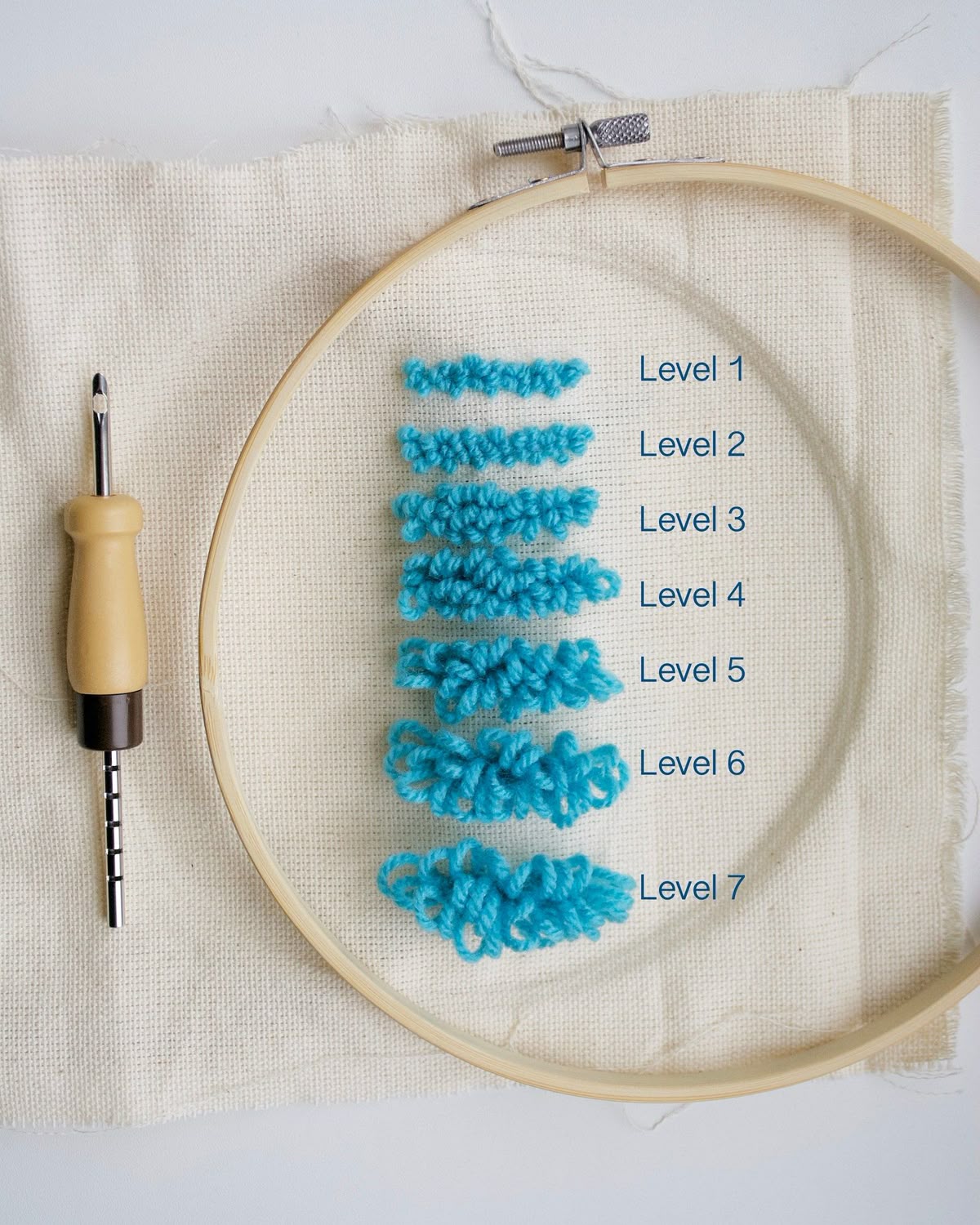
Punch needle is the technique of pushing an open-tipped needle through fabric by hand so that a loop forms on the other side. It uses the same physics as tufting: the yarn is not knotted, it is held by friction inside the weave. The difference starts with what moves the tool. Your wrist moves a punch needle; a motor moves a tufting gun. That single difference then separates their scale, speed, fabric and finishing.
How punch needle works#
The needle is a hollow tube. Yarn runs through the tube and comes out of a hole near the tip. You push the needle into the fabric all the way to the stop, pull it back just far enough that the tip never leaves the surface, slide a few millimeters sideways and push again. As long as the tip stays in contact with the fabric, the loops come out even. Lift it and the last loop pulls right back out, which everyone experiences on their first try.
The working side is different too. In punch needle you look at the back of the piece while the loops form on the other face. You are watching a mirror image of your design as you go. For lettering or an asymmetric figure, the pattern has to be drawn reversed.
Needle length sets loop height. Adjustable models give a pile of roughly 6 to 15 millimeters; fixed needles give whatever they give.
The length adjustment is a simple mechanism. A lock lets you extend or shorten the part of the needle that stays inside the body; pull the needle out by 3 millimeters and the pile grows by 3 millimeters. Long pile will not hold on every fabric, though. Past 12 millimeters the loops start backing out under their own weight, so long pile work needs a tightly woven cloth and a hoop tension that never slackens.
How it differs from a tufting gun#
- Power: punch needle runs entirely on wrist force and needs no cable or socket. A tufting gun has a motor and needs electricity.
- Speed: I fill a 30x30 centimeter area with the gun in 20 to 30 minutes. The same area takes me half a day with a punch needle.
- Scale: punch needle is comfortable between roughly 20x30 and 50x70 centimeters. Tufting handles panels of 120x180 and beyond.
- Yarn: punch needle mostly runs a single thick strand. A tufting gun pulls yarn fast and usually wants 2 to 4 finer strands fed together. I went into yarn structure in types of tufting yarn.
- Fabric: punch needle uses tightly woven cloth that closes around the hole the needle makes. Tufting cloth is heavier and has to stay far tighter.
- Noise: punch needle is silent. You can work at night, in front of the television, while a baby sleeps. None of that applies to the gun.
- Undoing mistakes: pulling out a wrong area of punch needle takes minutes. Removing the same area of tufting stresses the backing.
Why the weave of the fabric matters#
Punch needle and tufting do not run on the same cloth, and the reason is the structure of the weave.
Punch needle uses tightly woven cotton such as monk's cloth. When the needle enters, it does not cut the threads, it parts them; as the needle withdraws, the weave closes back and grips the yarn. That grip is what holds the loop in place. If the weave is loose, the yarn sits free in the hole and pulls straight back out the moment you lift your hand. If it is too tight, the needle will not pass, and forcing it tears the cloth.
Tufting cloth is heavier and more stable. The needle of a gun strikes dozens of times per second, so the fabric cannot flex on every hit. You can stretch monk's cloth on a frame and work it with a gun, but past a meter the middle begins to sag. With punch needle the hoop rarely exceeds 30 centimeters, so the problem never comes up.
Hoop or stretcher frame#
A gripper hoop is enough for punch needle. Hoops of 15 to 30 centimeters are the most common; plastic teeth inside grip the cloth and you set the tension by hand. For larger work people use stretcher bars, with 30x40 centimeters a typical size.
Tufting will not tolerate that. If the fabric flexes back when the needle strikes, the loop does not hold, so carpet gripper strips are nailed to a wooden frame and the cloth is pressed onto those pins. Frames are usually 100x150 centimeters or bigger. I described the whole setup step by step in how a tufted rug is made.
Yarn consumption#
Covering the same area takes more yarn with a gun than with a punch needle. Pile height and stitch density are the reason: in tufting the loops are packed until they touch, and the pile usually sits above 10 millimeters. Tufting a 30x30 centimeter area at 12 millimeters uses somewhere between 180 and 250 grams of yarn. Filling that same area by punch needle at 8 millimeters stays around 100 grams.
Finishing and durability#
In both techniques the loop is held by friction, so an unfinished back means the piece falls apart over time.
On punch needle work, a thin coat of textile glue on the reverse is often enough. Because the piece is small, folding the fabric behind a frame and stapling it is a valid finish as well. If it will be used as a cushion face, felt or lining fabric is sewn to the back, since glue alone does not survive washing and friction.
Tufting is heavier work. A thick glue layer goes on the back, a secondary backing is pressed onto it, woven tape is run along the edges and the piece is left to cure. A rug that will meet feet, friction and a vacuum needs every one of those layers.
On durability: a properly finished punch needle panel will hang on a wall for years without trouble, but it was never designed to be walked on. If you want a floor rug, tufting is the right technique.
Choosing between them#
Answer two questions and the choice makes itself.
First, how big is the piece? A panel under 40 centimeters, a cushion face, a detail on a bag or a name sign is ideal punch needle territory. Past a meter, punch needle puts a serious load on your wrist joint, and at that size the gun makes more sense.
Second, is it going on the floor or the wall? Floor means tufting.
There is one practical difference beyond that. Punch needle takes an afternoon to learn. Getting tension, angle and depth right at the same time with a tufting gun takes weeks. If you want to get your hand used to looped surfaces, punch needle is a good place to start.
Where you live matters too. A tufting gun makes a noise close to a power drill, so working in an apartment in the evening means trouble with the neighbors. A punch needle is silent, travels in a bag and gets done in the chair you are already sitting in.
The size at which punch needle stops making sense is, for me, 60 centimeters. Past that a hoop is not enough, stretcher bars have to be built, the job stretches from days into weeks and the wrist takes a beating every session.
I use both in the studio, but the weight of production sits on the tufting side. Wall panels and floor rugs need the scale and the texture depth the gun makes possible. You can see how that difference reads in finished work in the gallery.
Frequently Asked Questions
Are punch needle and tufting the same thing?
The underlying idea is the same: yarn is pushed into fabric and left there as a loop. The difference is that a punch needle is driven by your hand while a tufting gun is driven by a motor. That one difference changes the speed, the workable size and how tightly the fabric has to be held.
Can you make a floor rug with punch needle?
You can try it at doormat size, but it is not the right tool for the job. A floor rug meets friction, body weight and a vacuum, which calls for a thick glue coat, a secondary backing and edge tape. Punch needle work is normally made for wall panels, cushion faces and small decorative pieces.
Which one is easier to learn?
Punch needle. The basic motion settles in over a single afternoon. With a tufting gun, holding tension, grip angle and needle depth right at the same time takes weeks, and early pieces usually come out with a rippled surface.
Can punch needle pieces be washed?
Not in a machine. Soaking a piece whose back is fixed with glue softens that glue and lets the loops work loose. The safest method is to press a damp cloth onto the stained area without rubbing it.