Inspiration
A First-Time Buyer's Guide to Original Art
How do you choose a budget, size, technique and place for your first artwork? A practical guide using real works currently available.
You do not need to be an art historian to buy your first artwork. Set a budget, measure the place where it will live, read the product record and choose a piece you want to see every day. A good first purchase is not the work you imagine other people will value. It is one with clear information, a price you can afford and an image that keeps your attention.
Indecision often comes from trying to solve every choice at once. Begin with budget and place, then consider technique and the individual piece. That order makes a long gallery easier to navigate.
Set a realistic budget range#
Write down a comfortable range instead of one hard ceiling. If it is TRY 2,000 to TRY 5,000, decide whether that includes possible framing and shipping. A work on paper may need protective framing. A canvas can sometimes hang without an outer frame, but it still needs suitable wall fixings.
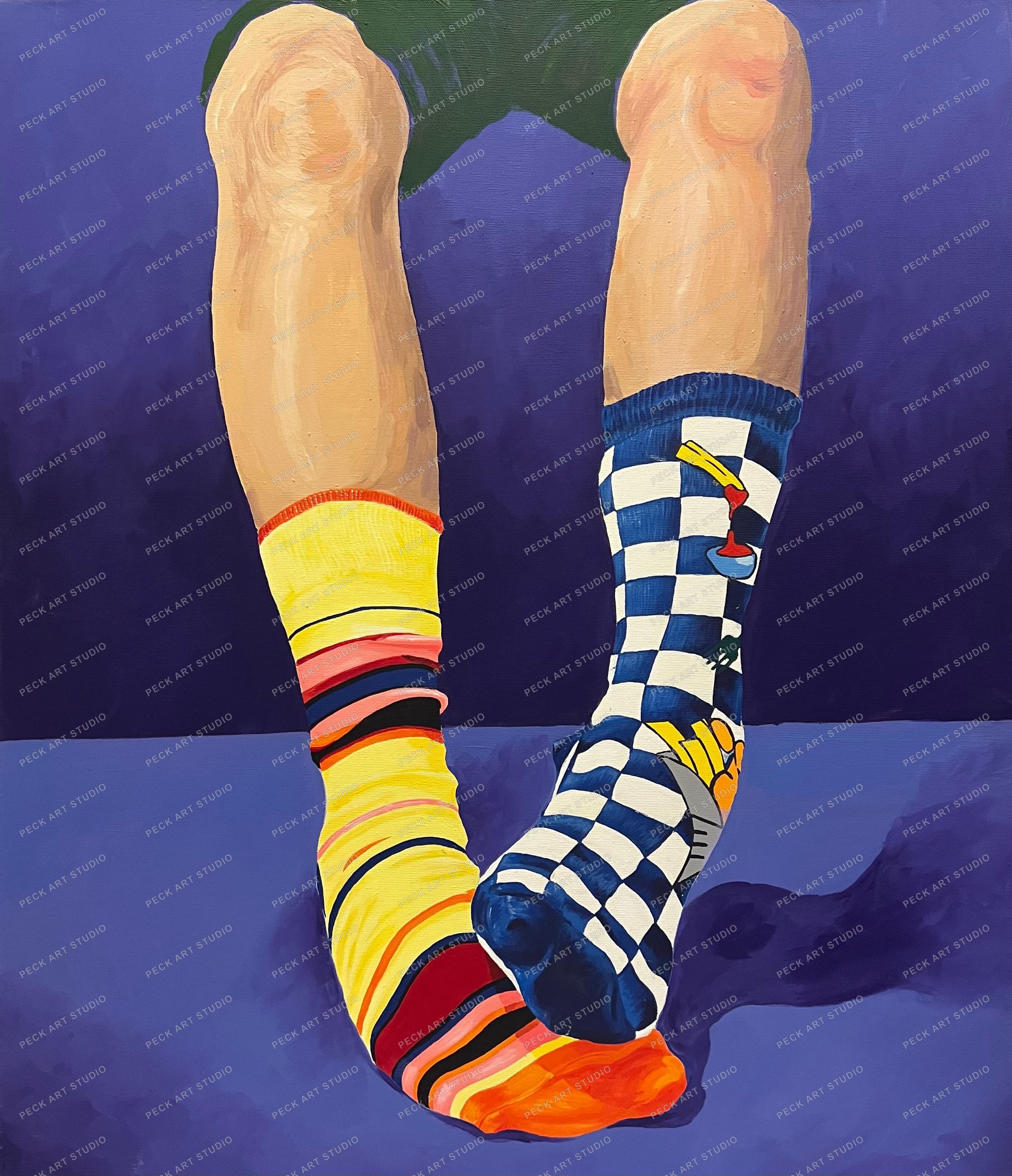
Among Peck Art Studio paintings available on 8 September 2026, the 50x70 cm Kabaklar is listed at TRY 2,000, the 35x50 cm Nefertiti at TRY 3,000 and the 60x70 cm Eş Çorap at TRY 5,000. Larger acrylic works include Salt Galata at TRY 10,000, Parsel Dokuma at TRY 13,000 and the 120x180 cm 1982 Zıvarık at TRY 20,000. The range shows that a first work need not be the smallest or cheapest and that original options exist across several budgets.
Do not justify the price through an expectation of investment return. Future appreciation cannot be guaranteed. The tangible return on a first artwork is living with it and owning an object whose maker is known.
Measure the wall and viewing distance first#
Learning the size after falling for the image is a common mistake. Measure the wall width, nearby furniture and the distance from which you will see the work. Mark its dimensions with masking tape. A 35x50 cm piece can sit comfortably near a desk; a 120x180 cm canvas needs a broad wall and greater viewing distance.
If the work will hang above a sofa or console, do not estimate the relationship from a photograph. Leave the tape in place for two days. Look in daylight and under evening lighting. The artwork lighting guide covers direct sun and artificial light in more detail.
Measurements for paper works often describe the art surface; a mount and frame increase the outside dimensions. A frame can do the same for canvas. If an artwork appears framed in its photograph, ask whether the frame is included.
Choose a technique that suits you#
Acrylic on canvas, dry pastel, engraving and linocut differ in care as well as appearance. Acrylic canvas can be displayed without glazing. Dry pastel and other paper work are better protected in a glazed frame that does not touch the surface. Acid-free mounting helps preserve engravings and linocuts over time.
If texture attracts you, explore the tufting collection. A tufted wall work holds light differently because of its raised yarn surface. A ready work has fixed dimensions and an established image. A commission allows design, colour and size to be discussed. For a first buyer who wants fewer unknowns, a ready work can be an easier start.
Do not rank techniques as status levels. An engraving is not less real than acrylic on canvas; an original print has its own production process. What matters is an accurate technique record and your response to the surface.
Work out whether you genuinely like it#
The most striking first image is not always the one you want to live with. Reopen it after a few days. Does your eye return to the same area, do you notice another detail, do you wonder how its colour will sit in your own light? These questions remove pressure from the decision.
Matching only the sofa colour can be restrictive. Furniture changes. A more durable test is what thought or feeling the work continues to create. Practical fit still matters: a wall in strong sun may be unsuitable for paper and pigment, while a large frame can become a physical hazard in a narrow passage.
If you are choosing between two pieces, place screenshots beside each other at the same scale. Then write the actual dimensions, technique and price from each product page in a separate note. It becomes easier to keep visual preference and practical fit distinct.
Read the artist and artwork record#
An artwork description should be more than decorative copy. Look for artist, technique, size, year and materials. Is the piece unique, part of an edition or a reproduction? Where are the signature and identifying details? These questions matter for a first modest purchase as well as a major collection.
Peck Art Studio works are made by Nazife Ünal Tekin. Verifiable education and practice information is available on the about page. Works are offered as unique pieces and carry studio details on the reverse. The approach is explained in certificates of authenticity.
Do not fill a blank product field with your own assumption. Ask before paying, particularly about materials, frames and condition. A clear seller will not dismiss a first-time buyer's questions.
A collection begins with one work#
The word collection can suggest many expensive pieces. In practice, it begins with one work you can explain choosing. There is no need to buy the second immediately. Seeing the first under different seasonal light and in different positions teaches you what to look for next.
For an accessible size and price, consider original prints. Kabaklar is a 50x70 cm colour linocut and Nefertiti a 35x50 cm engraving. For acrylic on canvas, Eş Çorap at 60x70 cm offers another starting point. These were available on 8 September 2026; each artwork page carries the current status.
You do not need a theme at the beginning. Different techniques, artists and periods can sit together over time. Trying to design a perfect collection on day one may stop you from choosing the single work you love.
Understand payment and delivery#
A Buy option appears on Peck Art Studio works that are available for online purchase. After delivery details, card payment is completed in PayTR's frame. Artwork price, any shipping charge and the total appear separately. Card details are not stored in the studio's form.
Ready works are packed and handed to the carrier within one to three business days after payment reaches the seller. Inspect the parcel with the carrier present. For visible damage, request a report before accepting it. Read current withdrawal, return carrier and refund details in the delivery and returns terms.
A commission follows a different process. Design and dimensions are discussed, a quotation is given and the schedule depends on the order. Goods made to personal specifications may fall under an exception to withdrawal rights, so read the contract before accepting it. If you want your own idea made, submit a request through the custom order page.
Five minutes before the decision#
Before selecting Buy, make five checks:
- Is the total within your budget?
- Have you seen the dimensions at full scale on the wall?
- Are technique, materials and edition status clear?
- Have you allowed for framing and care?
- Have you read delivery, damage and return terms?
If all five are complete, return to the visual decision. Open the painting collection and notice which work you view twice. Then verify its size and technique on the artwork page. Your first purchase becomes simpler, informed and genuinely yours.
Frequently Asked Questions
How much should I budget for my first artwork?
There is no single correct figure. Set a range you can comfortably afford and include possible shipping, framing, mounting and wall-fixing costs.
Should my first work be a canvas or an original print?
Either can work. There is no status ranking between canvas and an engraving or linocut. Decide through visual preference, care needs, dimensions and budget.
How can I test artwork size at home?
Mark the listed centimetres on the wall with masking tape and leave it for a day or two. View it by day and at night, adding space for the outer frame if needed.
Is buying art an investment?
Future appreciation cannot be guaranteed. For a first purchase, focus on verifiable information, an affordable budget and whether you want to live with the work for years.
Is a ready work or a commission easier for a first buyer?
A ready work already has a fixed image, size and price, so it carries fewer unknowns. With a commission, design, colour, dimensions, quotation and schedule are agreed together.