Decor
Decorating With Wall Textiles: Warmth, Acoustics and Character
A textured surface on a wall does more than decorate: it cuts echo, softens light and warms a room. Which rooms suit it, and how to use it well.
Updated:
Modern homes share a problem: a lot of glass, hard floors, flat walls, little textile. The result is spaces that photograph beautifully but feel slightly cold and echoey to live in.
A textured surface on the wall is the most direct answer to that. And it is not incidentally decorative, the effect is measurable. This article explains it and how to use it.
Three real benefits of textile on a wall#
The aesthetics are obvious; these are the interesting parts.
It cuts echo. Sound reflects off hard surfaces and is absorbed by porous, piled ones. In a room with a high ceiling, wood or tile floors and little furniture, speech rings. A few square metres of textured surface on the wall visibly reduce that ring. The difference is most obvious in open-plan offices and studio flats.
It softens light. A glazed, framed print reflects light; from certain angles the glare makes the piece invisible. A textured surface absorbs and scatters light and looks the same from wherever you stand.
It adds warmth. More subjective, but the most noticed. Textile gives a sense of being lived in that no print can. Of two pieces in the same room, the textured one almost always feels more like home.
Which rooms benefit most#
The places where it makes a difference are clear:
- Living rooms with high ceilings. Where echo is heard most
- Hard-floored rooms. Wood, tile, marble, if there is no rug, the wall takes over
- Heavily glazed, north-facing rooms. The light arrives cold and flat; texture balances it
- Above a bed. Acoustics, softness, and the advantage of not hanging glass over your head
- Open-plan offices and studies. Sound reflection directly affects concentration
- Stairwells and hallways. The most echoey and most neglected spaces
There are places where it helps less: rooms already carpeted, curtained, heavily furnished and low-ceilinged are already textile-saturated, and there a textured panel is purely an aesthetic choice.
Size: do not go small#
Acoustic effect is proportional to area. A 40x40 panel can look lovely but does nothing to the sound.
For a noticeable difference you need at least half a square metre, preferably around one. Practically:
- For a clear effect: 70x100 cm and above
- Living room wall, single piece: around 80x120
- Several pieces: calculate the total area, which does the same job as one large piece
The general rules for sizing against furniture are in the sizing guide: the piece should be about two thirds the width of the furniture beneath it.
Combining with other work#
A wall textile does not have to stand alone; the mix is what is really good.
Placing a single textured piece among framed works on a gallery wall adds depth to the composition. Where a wall of glass and frames tires the eye, one matte, piled surface breaks the rhythm.
The only thing to watch: do not make the textured piece the largest or closest to centre, or it overwhelms the others and speaks alone. It works better in side positions and at mid scale.
We gathered different layout approaches in the empty wall article.
Balancing colour and texture#
A warning: a textured surface is already visually dense. Add a busy pattern and many colours on top and the room falls apart.
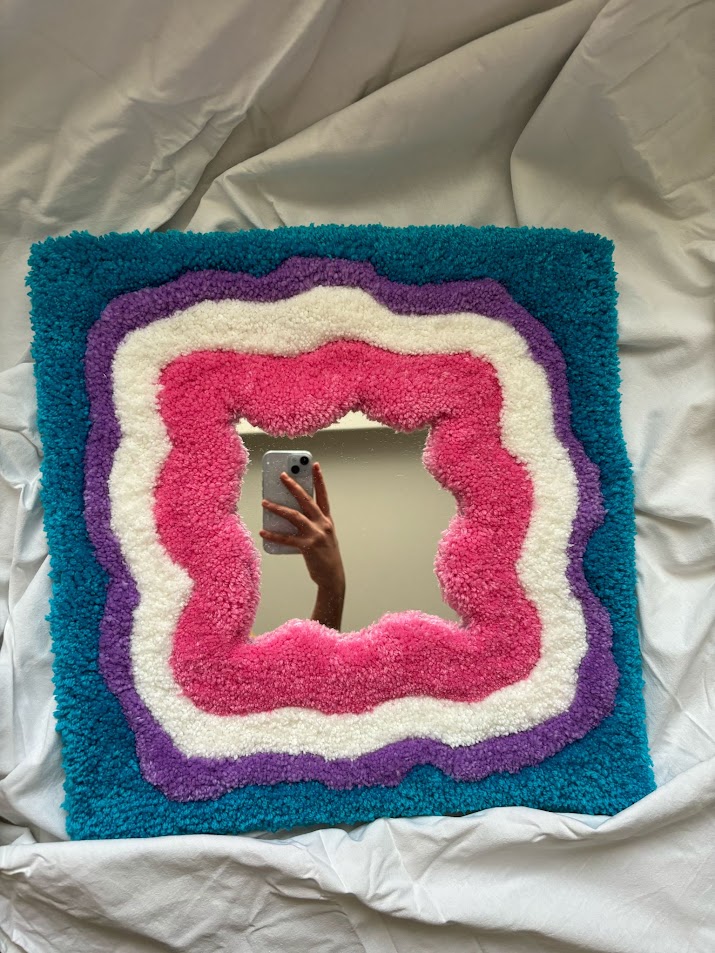
A practical rule: as texture rises, the design should simplify. The tufted pieces that look best are usually two or three colours with broad forms. That also suits the nature of the technique, yarn thickness already limits fine detail.
On colour, taking the quietest colour in the room and using a shade of it as an accent works almost every time.
Choosing the surface type#
For hanging work, durability drops out of the equation, so the choice is purely about appearance.
Cut pile reads velvety and deep with soft colour transitions. It absorbs the most light and is the most effective acoustically.
Loop pile reads flatter and more graphic with crisp pattern edges. The right choice for geometric work and lettering.
Combining both in one piece works particularly well on a wall: it creates a difference in light even within a single colour, and the piece changes through the day. We opened up the difference separately.
Hanging and care#
A textured panel hangs slightly differently from a framed picture: use two points or a concealed cleat rather than a single nail, and the panel should sit flush to the wall. We covered hanging methods separately.
Care is simpler than expected. A piece on a wall is never walked on, so it stays as it was for years. Occasional dusting and keeping it out of direct sun is enough. The full care guide is a separate article.
One warning: do not hang on damp external walls. If air cannot circulate behind it, moisture affects the backing.
Where to start#
The easiest way to tell whether your room echoes: stand in the middle and clap. If you hear a short ring after the clap, a textured surface will genuinely help in that room.
The gallery holds tufted work suitable for hanging, with dimensions and prices on each page. If your wall needs a particular size or palette, send a photo of the space through the custom order page and we will set the size and colour to the room together.
Frequently Asked Questions
Does hanging a rug on a wall really affect acoustics?
Yes. Sound reflects off hard surfaces and is absorbed by porous, piled ones. In high-ceilinged, hard-floored, sparsely furnished rooms, a few square metres of textured surface visibly reduce the ring. The effect scales with area, so small panels make little difference.
Which rooms benefit most from a wall textile?
High-ceilinged living rooms, hard-floored rooms, heavily glazed north-facing spaces, above a bed, open-plan offices and stairwells. In rooms already carpeted, curtained, heavily furnished and low-ceilinged, the benefit is largely aesthetic.
What size should a wall panel be?
For the acoustic effect to be felt you need at least half a square metre, preferably around one — in practice 70x100 cm and above. For a single piece on a living room wall, around 80x120 works well. Several pieces achieve the same through their total area.
Can a wall textile be combined with framed pictures?
Yes, and the mix gives the best result. On a wall of glass and frames, one matte, piled surface breaks the rhythm. The only thing to watch is not making the textured piece the largest or most central, or it overwhelms the others.
Is a tufted wall panel hard to look after?
No, simpler than a floor rug. Never walked on, it stays as it was for years; occasional dusting and keeping it out of direct sun is enough. The one warning is not to hang it on a damp external wall, since moisture affects the backing if air cannot circulate behind it.