Inspiration
From the Studio: Nazife Ünal Tekin's Creative Process
From ceramics to canvas to tufting: how does a piece come into being in the studio? Light, material, the first sketch, and the story of one real commission.
Updated:
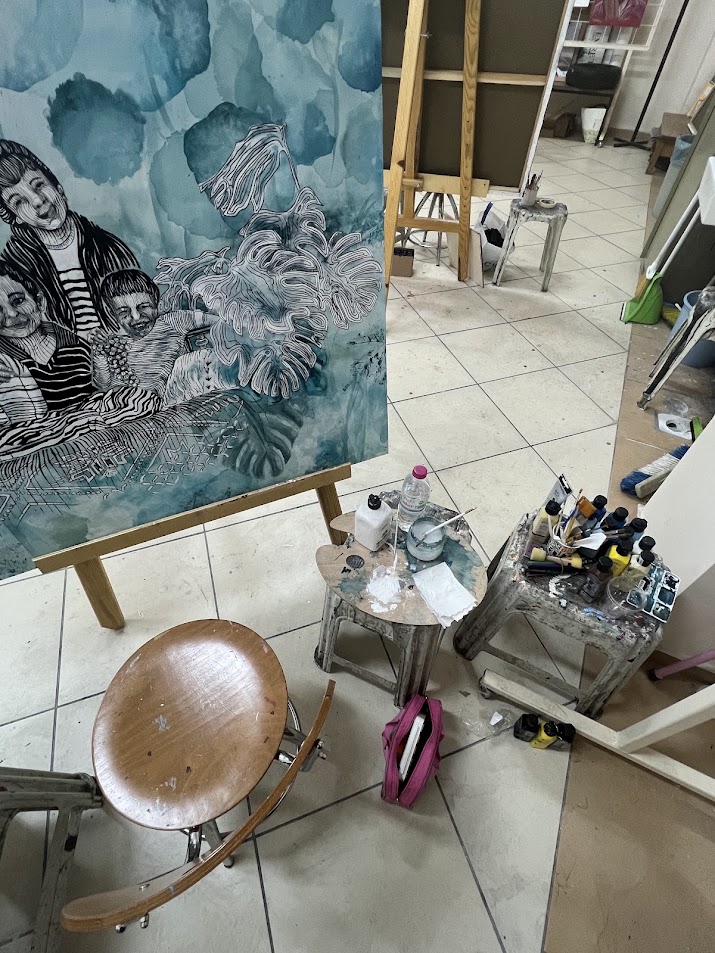
Every piece at Peck Art Studio is made by one person. The same person takes the order, draws the sketch, punches the yarn and packs it. That makes the process both slow and very personal.
This article gathers notes written from inside that process: how an idea becomes a work, why light matters so much, what the material dictates, and what happens when a finished piece enters someone's home.
A grounding in craft#
Nazife Ünal Tekin's practice comes out of ceramics. She studied ceramics at Akdeniz University's Faculty of Fine Arts, then art teaching at Necmettin Erbakan University.
What that combination means in practice: ceramics is a field where the material sets its own rules. You do what the clay wants; force it and it breaks. That habit carries into both tufting and painting, looking less at what you want the material to do than at what it is able to do.
Which is why Peck Art Studio is not confined to a single technique, working across a range from ceramics to canvas to tufting and handmade design.
It begins with an idea#
Every piece starts with a sketch, and that sketch is almost always an exercise in simplification.
In tufting it is compulsory: since the smallest unit on the surface is the thickness of the yarn, fine detail cannot be carried. So the design stage is really a "what do we remove" stage. A good tufting design is what remains once everything removable has been removed.
Painting has no such limit but imposes another discipline: surface preparation. Skip the priming and the paint sinks into the fibre, dulling over the years. I covered types of canvas and how oil paint works separately.
Light: the most overlooked variable#
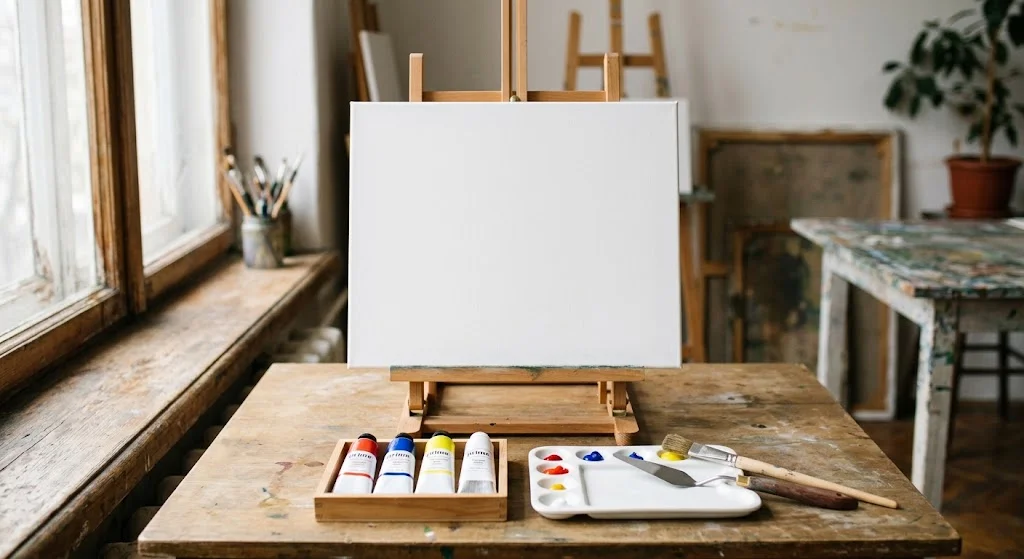
What makes the most difference in the studio is something most people never consider: what time of day you work.
In summer the light in the studio changes entirely. At nine in the morning the light through the window takes on a yellow I never see in winter, and that makes the yarn in my hands read as a completely different colour.
So on some days I prefer to work early, before the light hardens, when I can see the colours closer to how they really are. Towards midday, when the sun is overhead, I move the yarn boxes into shade, because choosing colour in direct light has always misled me.
Something similar happens with painting. In summer bright, saturated colours feel closer to me; in winter I drift towards earth tones and grey. I suspect the season outside seeps into the brush without my noticing.
The same issue applies to whoever buys the piece: a work reads cold in a north-facing room and warm in a south-facing one. I covered choosing colour separately.
A dialogue with material#
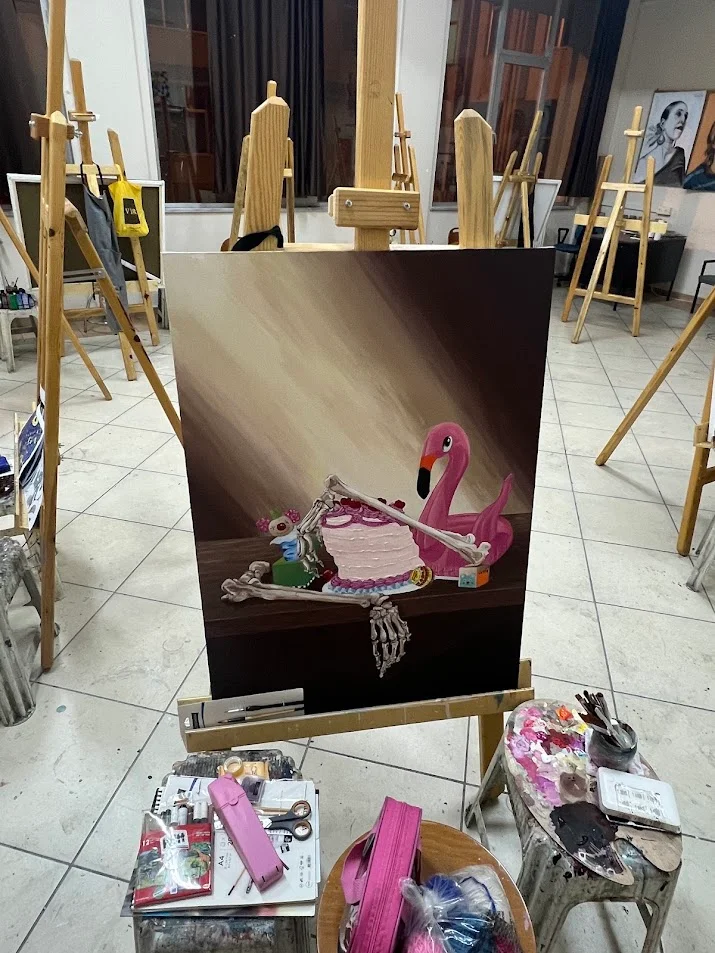
Tufting and painting look like very different techniques at first glance, yet both share the same root: filling a surface with meaning. Brushstrokes carry emotion just as threads do.
The difference shows in light. Yarn absorbs it, giving a soft, three-dimensional texture, allowing great freedom in colour transitions and bringing warmth to modern interiors. Paint reflects it, reading sharper and more graphic.
When the two come together the result is not just visual harmony but a tactile experience: a piece on the wall that is both seen and felt. I compared choosing between tufting and painting separately.
A day in the studio#
On a tufted piece the day starts with the frame. The backing cloth is stretched onto a wooden stretcher, and this step is never rushed: the tension has to be equal at every point, or the surface ripples, and that ripple never comes out later.
What follows is long and repetitive. Filling one square metre takes between one and three days depending on density. While working you look at the reverse of the cloth, you cannot see the surface you are making as you make it. That is the part of tufting that takes the most practice.
My favourite stage is shearing. The surface coming off the frame is still untidy; you cut a little, look, cut a little more, because yarn you remove does not come back. It shapes the final appearance more than any other step. I described all seven stages separately.
The story of one commission#
A customer called to say she wanted something for the home she had just moved into. On the phone she talked at length about the light in the house and the colour of the walls; it was not a precise brief so much as a feeling, "I want to feel good sitting there."
We proposed a design accordingly: a tufted panel in warm earth tones with soft transitions. When we sent the first sketch she hesitated and asked, "is it too plain?" We made a small revision together and deepened a couple of the tones.
When the panel reached her home she sent a short message: "It was the first place I looked the moment I walked in."
That sentence is the real return for us. More than any effusive thanks, someone feeling good in their own home.
Stories like that remind us why we work so carefully in the studio. Every order is a small touch on somebody's daily life.
Why one person makes it#
The reason the process is so slow is simple: you cannot tuft two pieces at once. You can start another while one is curing, but the production itself does not divide.
There is a return on that: because the person who takes the order is the person who punches the yarn, a conversation at the design stage translates directly onto the surface. There is no intermediary.
Average delivery is 21 days, and that is why the figure is honest. I described the ordering process in detail.
Seeing the studio#
If the process interests you, you can see finished work in the gallery, with technique, dimensions and year on each piece's page. I wrote about how to navigate the collection separately.
If you are thinking of something in your own size and image, you can start on the custom order page, and read more about the artist on the about page.
Frequently Asked Questions
Who is Nazife Ünal Tekin?
The founder and artist behind Peck Art Studio. She studied ceramics at Akdeniz University's Faculty of Fine Arts and then art teaching at Necmettin Erbakan University. She works across a range from ceramics to canvas to tufting and handmade design.
Who makes the pieces?
One person makes all of them. The same person takes the order, draws the sketch, punches the yarn and packs it. Since two pieces cannot be tufted at once the process is slow; in exchange, a conversation at the design stage translates directly onto the surface, with no intermediary.
How long does a piece take to make?
About 21 days on average. The tufting itself takes one to three days per square metre depending on density; the rest goes to design, stretching the frame, curing the backing, shearing and edge finishing.
Why does light matter so much in the studio?
Colour choice depends entirely on it. At nine on a summer morning the light through the window takes on a yellow never seen in winter, making the yarn read as a different colour. So colour decisions are made early, before the light hardens, and the yarn is moved into shade at midday — choosing colour in direct light misleads.
Can I have a say at the design stage?
Yes, and it is the most important stage. A sketch is sent and revised together. At the design stage anything can change; after transfer to the cloth colour can still be adjusted but composition becomes difficult, and once the backing is applied nothing can change.