Inspiration
What Is Abstract Painting and How Do You Read It?
What do you actually look for in an abstract painting? Colour, form and texture, the old could a child do that objection, and how it feels to live with one.
Updated:
Standing in front of an abstract painting and not knowing what to think is a common feeling. A figurative picture hands you something to hold: an apple, a coastline, a face. Abstraction takes that handle away, and people quietly feel tested. What the work asks for is attention, not knowledge. Below is what abstraction actually is, and what to do in front of a piece.
What abstract painting means#
An abstract painting gives up showing a recognisable object from the visible world. The definition really is that short.
What it drops is resemblance, not subject. In a landscape, green serves the tree; the job of the colour is settled. In an abstract work that job disappears and colour becomes the subject. The same is true of form, texture, empty space and scale.
There is a wide middle ground too. A figure stays readable but distorted, or a coastline is reduced to three bands of colour. Partial abstraction covers most of what is actually painted.
A short line from Kandinsky to Rothko#
Vasily Kandinsky pushed the object off the canvas between 1910 and 1913. In his 1911 book On the Spiritual in Art he treated colour the way a composer treats a note: yellow sharp, blue deep, red insistent. The idea that a colour can carry a feeling on its own starts here.
Kazimir Malevich showed his Black Square on a white ground in 1915 and claimed a painting could exist without representing anything at all. In 1915 that was close to a scandal.
Mark Rothko built stacked fields of colour from the early 1950s onward. The detail most people skip: he said he painted large canvases in order to be close rather than distant, and wanted people to look from roughly 45 centimeters away. The rope barriers now standing in front of those works do the opposite of what he asked.
That is enough history. The useful part begins in front of the piece.
What to look at#
Colour
Find the dominant colour first, then find what balances it. Most well built abstract works have one colour family and a small accent that breaks it. An orange covering five percent of the surface can hold up all the blue around it. Cover that accent with your hand; if the composition collapses, you have just seen what the colour was doing.
Form and composition
Where does the weight sit? In the centre, or pushed toward an edge? A horizontal composition reads as calm, a diagonal one introduces movement. Empty areas are decisions too. The painter left them empty by choice, not because filling them was beyond reach.
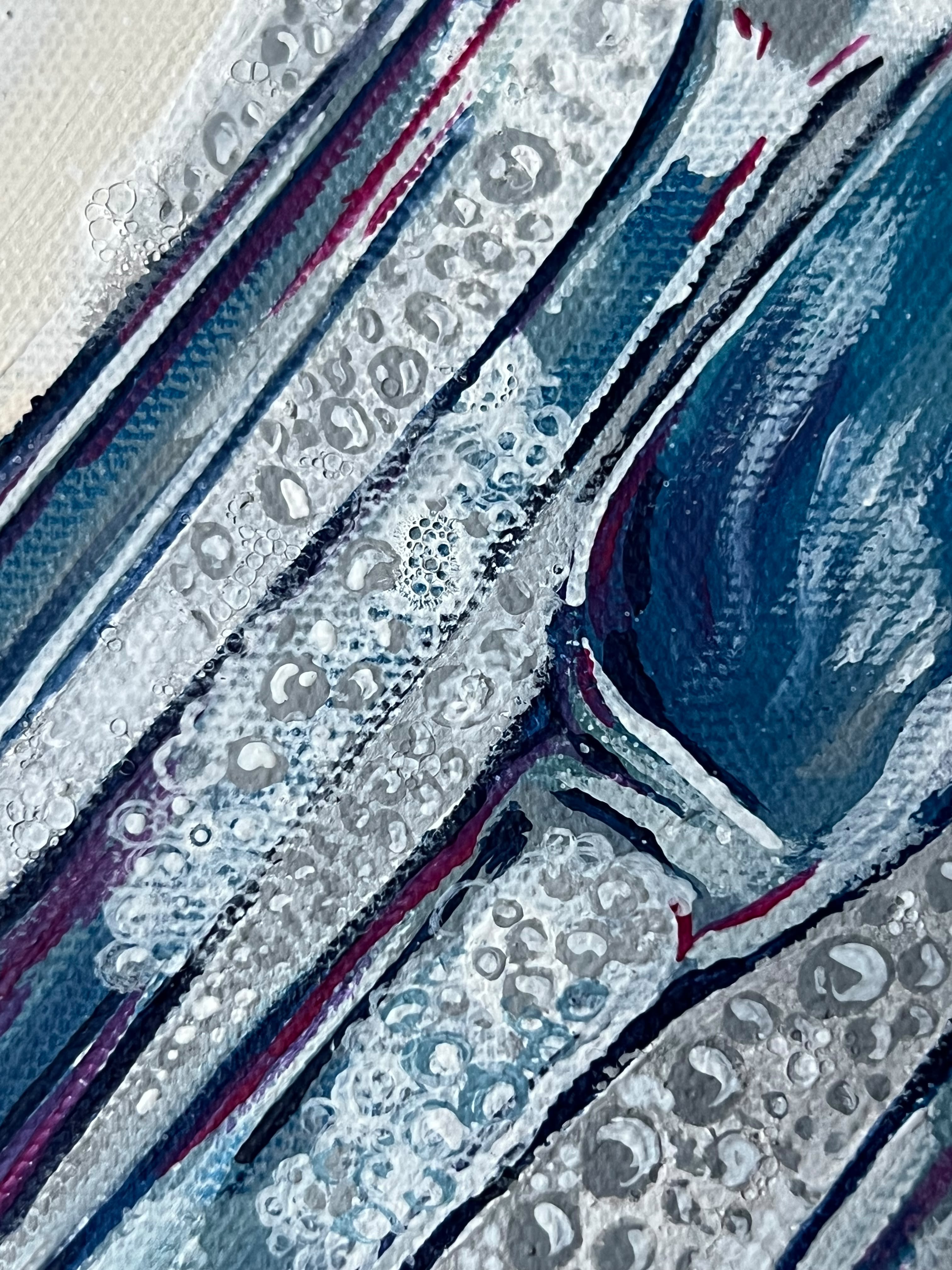
Texture and surface
Look at the surface from the side rather than straight on. A layer of acrylic is dry to the touch in 15 to 20 minutes at room temperature, so layers stack quickly and the brush marks underneath usually stay readable from the top. A thick acrylic ridge catches light, and the same work can look different in the morning and in the evening. Oil takes days to reach the same point, which is why the two materials produce very different abstraction. I went through that difference in detail in oil or acrylic.
Why so many pieces are called Untitled#
Titles like Untitled or Composition No. 4 are not laziness. They are a decision not to steer you. If the artist called the work Evening on the Shore, everyone would look for a shore, and anyone who failed to find it would feel short of something. With no title you are free. Some artists do the opposite and leave a small clue in the title; both are honest choices.
Could a child have done it?#
The objection is less empty than it sounds, which is exactly why it deserves a real answer.
Children paint freely and often beautifully. The difference is not in what gets made but in what gets left. A painter wipes out half a surface, corrects an edge three times, knocks a tone back by two degrees, and hardest of all decides where to stop. Rothko's apparently simple canvases came out of thin layers built over months. That simplicity comes from editing, not from speed.
The second test is consistency. Chance can produce one canvas. It cannot produce a coherent series of fifteen.
And part of the objection is fair. There is plenty of weak abstract work around: undecided colour, marks with no reason behind them, surfaces that behave like wall filler. If you stand in front of a piece for three minutes and find nothing to look at, the problem is not always you.
Living with an abstract piece#
Abstraction works where your eye passes every day. Not the corridor; the room where you sit, work and drink your coffee.
A usable rule for distance is about 1.5 times the diagonal of the work. A 100x140 cm canvas has a 172 cm diagonal, so the natural viewing distance is around 2.5 meters. If the gap between your seat and the opposite wall is under 2 meters, choose a smaller piece whose texture reads from close up instead of something wider than 140 cm.
For furniture the ratio that works is 60 to 75 percent of the width of whatever sits below. A 200 cm sofa takes a piece between 120 and 150 cm. Keep the bottom edge 20 to 25 cm above the sofa back; more than that leaves the work stranded on the wall.
Wall colour matters as much. Off white gives abstraction the most room. Charcoal or deep green pushes a brightly coloured piece forward, but swallows a low contrast, earth toned one.
One last practical habit: close the page of the piece you liked and open it again two days later. Work that hits you instantly often runs out quickly. If it still has something to say on the third look, it will live a long time in your home. Browse the gallery with that in mind.
Frequently Asked Questions
Do I need art knowledge to understand abstract painting?
No. Spending three minutes in front of a piece and noticing the dominant colour, where the weight sits and how the surface is worked usually gets you most of the way. Art history enriches the experience but is not a prerequisite.
Which room suits an abstract piece?
Rooms where you spend time looking: the living room, the dining area, a study. In a pass through corridor an abstract work usually goes unnoticed, simply because nobody stands still long enough.
How far back should I stand from an abstract painting?
A workable rule is about 1.5 times the diagonal, which puts a 100x140 cm piece at roughly 2.5 meters. Then look once more from 40 to 50 centimeters to read the texture and the brushwork.
What does it mean when a work is called Untitled?
It means the artist chose not to steer your reading. A title sends everyone looking for the same thing. Untitled leaves the interpretation with you, deliberately.