Inspiration
Painting with a Palette Knife: Techniques and Texture
A palette knife is not just for mixing. Hard edges, thick relief and scraped surfaces a brush cannot give all come from this tool.
Updated:
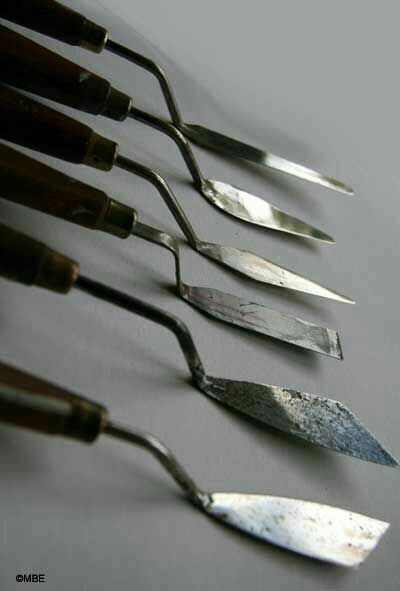
For most people a palette knife sits on the palette to mix paint. Used on the canvas, it opens a language a brush cannot give at all.
Why it differs from a brush#
A brush spreads paint onto a surface; a knife lays paint onto it. The difference shows plainly in the result.
A brushstroke carries the mark of the hairs and thins the paint. A knife mark is flat, its edges hard, and it keeps the paint thick. When light hits that thickness the surface itself casts shadow, so tone shifts even where colour does not.
Types of knife#
Two basic shapes, doing two different jobs.
A long, flat, flexible blade is for covering broad areas and laying smooth passages. You hold it almost parallel to the canvas as you drag.
A cranked, trowel-shaped knife is for thick paint and relief. The handle sits away from the surface so your hand never touches the work, which keeps things clean.
Small pointed ones are for detail and line.
The basic moves#
Dragging. Pick paint up on the underside, hold the knife at a shallow angle and pull in one move. Do not go back. The passage comes out flat with thick edges.
Pressing. Load the tip, press it to the canvas and lift straight up. Lifting leaves peaks of paint. The fastest way to make texture.
Scraping. Pass the sharp edge across wet paint. The top layer comes away and the colour beneath appears as lines. Common in abstract work.
Edge drawing. Hold the edge upright and pull for a thin, hard line. Getting a line that crisp with a brush is difficult.
Which paints suit it#
Acrylic and oil. Both can go on thick and hold relief.
Thick acrylic loses volume as it dries, because the water in it evaporates. Mixing in modelling paste or a heavy gel medium compensates, keeping the volume and using less paint.
Thick oil takes weeks to dry. Rushed, the surface skins over while the body underneath stays wet, and it cracks later.
Watercolour and gouache do not suit this technique.
Mixing on the canvas#
The best part of knife work is not fully mixing on the palette. Half-mix two colours, lay them down, and you get a marbled, living surface. Trying the same with a brush usually ends in grey.
For this, mix as little as possible. Two or three passes are enough.
Cleaning#
A knife is far easier to clean than a brush, and that is not its only advantage. Wet paint wipes off with a rag; dried acrylic peels off with a thumbnail. Nothing builds up at the base as it does in a brush, so it lasts for years.
While working, wipe it at every colour change, or the previous colour contaminates the next mix.
Where to start#
Take a small canvas, one knife and three colours. Work with the knife only and do not pick up a brush at all. The constraint speeds up learning.
Your first pieces will come out thick and messy, which is normal. Finesse with a knife comes with time.
Once a thickly painted work has dried it wants varnish; a raised surface collects dust and varnish makes cleaning easier.
Frequently Asked Questions
Which paint works with a palette knife?
Acrylic and oil. Both can be laid thickly and hold relief. Watercolour and gouache do not suit it, since both are thinned with water and will not hold texture.
Why does thick acrylic sink as it dries?
The water in acrylic evaporates, so it loses volume. A thick ridge noticeably drops as it dries. Mixing in modelling paste or a heavy gel medium prevents it, keeping the volume and using less paint.
Can you do fine detail with a palette knife?
Yes, but within limits. Holding the sharp edge upright and pulling gives very crisp lines that are hard to get with a brush, and small pointed knives are made for detail. Still, the knife is essentially a tool for broad, textured work.
How do you start working with a knife?
Start with a small canvas, one knife and three colours, and do not touch a brush for that piece. The constraint speeds up learning. Your first attempts will be thick and messy; finesse comes with time.