Gifts
Commissioning a Pet Portrait: Canvas, Tufting and Choosing the Photo
Thinking of a portrait of your cat or dog? Which technique, which size and which photograph actually work, a practical guide from the studio.
Updated:
Pet portraits are the most requested commission of all. The reason is easy to understand: people take thousands of photographs of their animals and hang none of them. A portrait turns one of those photographs into something permanent.
Here is the good news: animal portraits work well more easily than human ones. This article explains why, and how to choose.
Why animal portraits work well#
There are three technical reasons.
First, the silhouette is strong. A cat or a dog has a form recognised at a glance, with clear proportions between ears, muzzle and body. That suits simplification enormously.
Second, the eye is less merciless than with a human face. On a person, a millimetre of shifted proportion is noticed instantly; with an animal, recognition depends more on characteristic markings, a patch, the set of an ear, an eye colour.
Third, and specific to tufting: fur texture and yarn texture suit each other. Describing a cat's coat in yarn reads far more naturally than describing human skin in yarn. The material agrees with the subject.
Which technique: tufting or canvas#
Both are made, and the choice depends on the room.
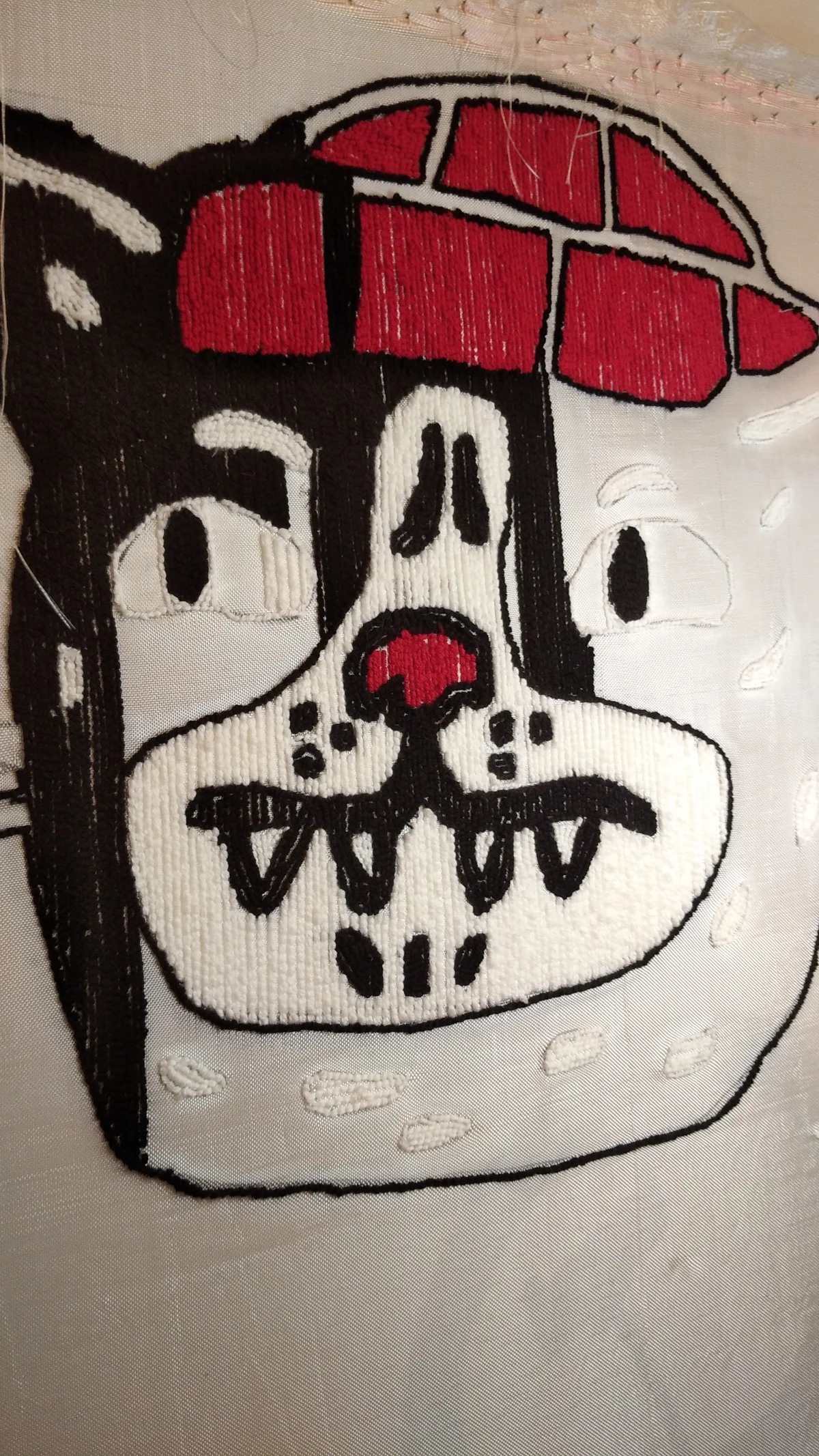
A tufted wall panel gives a textured, soft result. There is a logic to describing a furry animal with a furry surface; it becomes something you can touch. It warms a room and absorbs light. Rates start at 9,000 TL per square metre.
Acrylic on canvas reads sharper and more graphic. It can carry fine detail, whiskers, the catchlight in an eye, the tips of fur. It is lighter and thinner, and easier to hang. Rates start at 7,000 TL per square metre.
Roughly: if a characteristic pose and strong colour lead, choose tufting; if the fine expression in the face leads, choose canvas.
We also compared tufting and painting in general.
Size: do not go small#
This is the most common mistake. Because the animal is endearing, a small piece is requested, and the result falls flat.
Practical thresholds:
- A single animal on a tufted panel: at least 60x60 cm, preferably 70x70
- A single animal on canvas: 50x70 works, 40x50 is borderline
- Two animals together: at least 80x80, or 70x100 landscape
The reason is simple: facial detail relates directly to size. In tufting, yarn thickness sets a natural limit; as the piece shrinks, the distance between eyes and nose approaches that limit and the likeness disappears.
Which photograph works#
You have hundreds of photographs, and your favourite is probably not the most suitable. What to look for:
- Taken at eye level. Photographs from above enlarge the head and shrink the body, distorting the proportions
- Sharp. Blurred action shots, however charming, do not become portraits
- Natural light. Beside a window is ideal; flash flattens fur texture entirely
- A plain background. Rug patterns, furniture and cluttered floors swallow the subject
- Characteristic markings visible. The white patch on the chest, a notched ear, one eye a different colour, recognition largely lives there
Send more than one photograph. We usually take one frame as the main reference and complete a colour or a detail from a second.
For an animal that has died#
A significant share of these requests are memorial pieces, and usually only a few photographs exist, most taken on a phone in an ordinary moment.
What I want to say is this: send them even if the quality is not ideal. Characteristic pose and colour can be drawn out even from a soft frame. In this kind of work the aim is not to copy a photograph but for the animal to be recognised.
For such a commission I recommend going a little larger. Memorial pieces tend to hang alone, and if they are small they never find the place they deserve.
Price range#
Price comes from area, technique and detail density. Portraits fall into the "high detail" tier by their nature.
Concrete examples:
- 60x60 tufted wall panel, high detail: roughly 4,700 - 5,700 TL
- 70x70 tufted wall panel, high detail: roughly 6,400 - 7,800 TL
- 50x70 acrylic canvas, high detail: roughly 3,500 - 4,300 TL
- 70x100 acrylic canvas, high detail: roughly 7,100 - 8,600 TL
A wooden frame adds 2,000 TL. The base price is 3,500 TL. We explained the full pricing separately.
Process and timing#
About 21 days. If it is a gift, start at least a month ahead.
Briefly: you choose size and technique on the custom order page and upload the photographs, I confirm the firm price and date, and production begins with a 30 per cent deposit. I show you the draft at the design stage, you know your animal better than anyone, so your feedback at that point matters most.
I described the whole process and what can be changed at which stage separately.
If you are giving it as a gift#
Pet portraits have one of the highest hit rates of any gift. The reason: you do not have to guess someone's taste, because they already love the animal.
Two warnings. First, if you have to obtain the photo discreetly, images saved from social media are usually heavily compressed; ask for the original where you can. Second, allow for the time.
We gathered the general rules of giving art as a gift separately too.
To begin#
If you are unsure whether your photograph is suitable, just send it. I will look and give you an honest answer: will this frame make a good portrait, and if not, which photograph or which size would be better.
You can upload up to three images through the custom order page; they are never published at any public address and are seen only by the studio.
Frequently Asked Questions
Which photograph suits a pet portrait?
One taken at eye level, sharp, in natural light, with a plain background. Characteristic markings matter — a chest patch, the set of an ear, eye colour — because recognition largely depends on them. Sending several photographs helps.
What is the minimum size for a pet portrait?
On a tufted panel, at least 60x60 cm for one animal, preferably 70x70; on acrylic canvas 50x70 works. For two animals together, at least 80x80 or 70x100 landscape. As the size drops, facial detail is lost.
How much does a pet portrait cost?
Portraits fall into the high detail tier. A 60x60 tufted panel is roughly 4,700-5,700 TL and 70x70 is 6,400-7,800 TL; a 50x70 acrylic canvas is 3,500-4,300 TL and 70x100 is 7,100-8,600 TL. A wooden frame adds 2,000 TL.
Can you make a portrait of a pet that has died?
Yes, and a significant share of requests are exactly this. Send the photographs even if the quality is not ideal; characteristic pose and colour can be drawn out even from a soft frame. For these pieces I recommend going a little larger.
Tufting or canvas — which is better for a pet portrait?
Tufting if a characteristic pose and strong colour lead; fur texture and yarn texture suit each other very well. Acrylic canvas is better if fine facial expression, whiskers and catchlights lead.